Notes:
1. In Memoirs of Captain Sam Bellamy, The Prince of Pirates, John Boyd wrote of a manuscript that he acquired access to that claimed to have been written by Bellamy. Unfortunately, no one else has seen this document and Boyd was not permitted to copy it. Aside from recounting Bellamy’s story, it also discusses Le Vasseur’s early life.
Born in 1683, Le Vasseur was the second son of a nobleman whose family lived on the Île de France near Paris. He studied both military history and religion, since he wasn’t destined to inherit his father’s land or title. At sixteen, he became a priest who wished to join the Knights of Malta. This required him to serve a year aboard one of their Mediterranean galleys, where they defended the Catholic faith against the Ottoman Empire. This service permitted Le Vasseur to implement the military strategies he had acquired and he soon acquired the nickname “La Buse” because “[l]ike a buzzard, he would jump from a perch on his ship to the deck of the victim’s ship plummeting downward in a spiral, twisting and turning with his sword in motion towards any enemy he saw, finally reaching his intended target who he ruthlessly dispatched.” (Boyd, 9) Whereas his fellow knights acquired significant treasure and led less than celibate lives, Le Vasseur donated his shares to the order and never took hostages. It was the custom to ransom these hostages and his not doing so angered other knights. Eventually, he asked to be released from his vows and sought a letter of marque from the king of France. After acquiring a ship, he spent seven years privateering in the Mediterranean before heading west to the Caribbean and becoming a pirate.
2. Jeremiah Higgins, who was captured in New York, was later released after news of King George I’s pardon was received. Cape Mayos is Cape Maisi, Cuba.
3. John Brown was found guilty of piracy and hanged.
4. Snelgrave remained a prisoner of the pirates for a month. When they sailed away, he was on shore. He and other captives eventually returned to Bristol on 1 August 1719. His account of the slave trade and his time with the pirates was published in 1734.
5. The Comoro Islands lie east of Mozambique and northwest of Madagascar.
6. By the time Macrae and his men arrived in Bombay, India seven weeks later, they were starving and dehydrated. The East India Company honored his bravery and appointed him to the position of Governor of Madras.
7. Cabo originally had seventy-two guns, but it is believed that the crew jettisoned many of the cannon to keep her afloat during the storm, which Colin Woodard identifies as a cyclone. Only several dozen crewmen were aboard when the pirates attacked. The rest were on the island.
8. This account, which was published in 1744, also claimed that Le Vasseur and some of his men planned to take the Cabo under cover of darkness and slip away to the Caribbean. When they were found out, all the pirates gathered and voted to oust Le Vasseur as captain. He and his fellow conspirators were then flogged and lost their shares of the treasure.
9. The value of the treasure in today’s currency exceeds $1,500,000.
10. When the Count returned to Portugal, his homecoming was not a happy one. He was banished from the royal court in Lisbon for a decade.
11. High and short meant that he was elevated sufficiently for everyone to see, but with a minimal amount of rope.
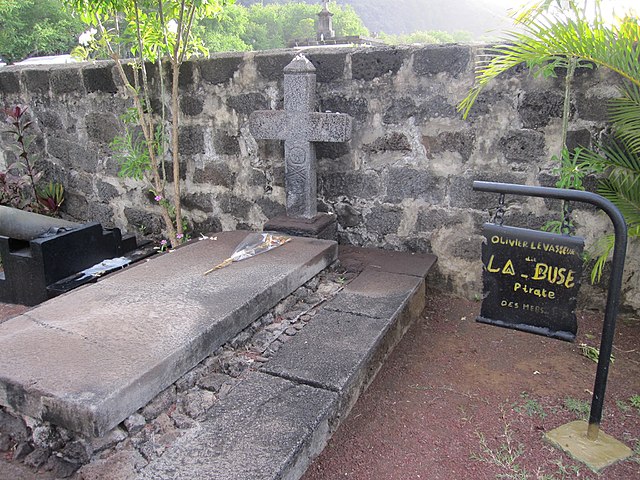
12. Today, Le Vasseur’s burial spot is popular with tourists visiting Réunion Island. Whether his remains are actually buried there is unknown.
For additional information I recommend the following resources:
Benaben, Yannick. “Sur les Traces du Trésor de La Buse Entre Histoire et Légendes Insulaires,” Au-Delà des Mers et des Océans 15 August 2015. (English translation)
Botting, Douglas. The Pirates. Time-Life Books, 1978.
Boyd, John A. Memoirs of Captain Sam Bellamy, the Prince of Pirates: Saint Croix, 1716-1717. CreateSpace, 2015.
Brooks, Baylus C. Quest for Blackbeard. Baylus C. Brooks, 2016.
Burl, Aubrey. Black Bart: The Real Pirate of the Caribbean. Sutton, 2006.
Captured by Pirates: 22 Firsthand Accounts of Murder and Mayhem on the High Seas edited by John Richard Stephens. Fern Canyon, 1996.
Cordingly, David. Under the Black Flag: The Romance and the Reality of Life among the Pirates. Random House, 1995.
De Bry, John. “Christopher Condent’s Fiery Dragon: Investigating an Early Eighteenth-century Pirate Shipwreck off the Coast of Madagascar” in X Marks the Spot: the Archaeology of Piracy edited by Russell K. Skowronek and Charles R. Ewen. University Press of Florida, 2006.
Dia, Luis. “Pirates, Gold and Ghosts: Goa’s ‘Treasure Island’ Connection Is a Movie Waiting to be Made,” Scroll.in 28 April 2017.
Dolin, Eric Jay. Black Flag, Blue Waters: The Epic History of America’s Most Notorious Pirates. Liveright, 2018.
Earle, Peter. The Pirate Wars. Thomas Dunne, 2003.
Fox, E. T. Pirates in Their Own Words: Eye-witness Accounts of the ‘Golden Age’ of Piracy, 1690-1728. Fox Historical, 2014.
Gosse, Philip. The Pirates’ Who’s Who. Rio Grande Press, 1924.
Konstam, Angus. The History of Pirates. Lyon, 1999.
Little, Benerson. The Golden Age of Piracy: The Truth Behind Pirate Myths. Skyhorse, 2016.
Marley, David F. Pirates of the Americas. ABC-Clio, 2010, 2: 1686-1725.
Mingren, Wu. “French Pirate Olivier Levasseur Left Behind a Curious Cryptogram – Does It Lead to His Long-lost Treasure?” Ancient Origins 19 November 2017.
Piat, Denis. Pirates and Privateers in Mauritius. Editions Didier Millet, 2004.
Rediker, Marcus. “The Seaman as Pirate: Plunder and Social Banditry at Sea” in Bandits at Sea: A Pirates Reader edited by C. R. Pennell. New York University, 2001, 139-168.
Rogozi?ski, Jan. Honor among Thieves: Captain Kidd, Henry Every, and the Pirate Democracy in the Indian Ocean. Stackpole Books, 2000.
Rule, Chris. “Piratical History of Madagascar,” Pirates! Fact & Legend. Date unknown.
Selinger, Gail. The Complete Idiot’s Guide to Pirates. Alpha, 2006.
Selinger, Gail. Pirates of New England: Ruthless Raiders and Rotten Renegades. Globe Pequot, 2017.
Snelgrave, William. A New Account of Some Parts of Guinea, and the Slave Trade. Gale, 2012.
“The Trials of Eight Persons Indited for Piracy,” British Piracy in the Golden Age: History and Interpretation, 1660-1730 edited by Joel H. Baer, volume 2. Pickering & Chatto, 2007, 289-319.
The Whydah Sourcebook compiled and edited by Kenneth J. Kinkor. Unpublished manuscript, 2003.
Woodard, Colin. The Republic of Pirates: Being the True and Surprising Story of the Caribbean Pirates and the Man Who Brought Then Down. Harcourt, 2007. |