
Women and the Jolly Roger
| View previous topic :: View next topic |
| Author |
Message |
Salty Dog
Sailing Master
Posts: 10063

192187 Gold -
         more... |
 Posted: Thu May 04, 2017 2:53 pm Post subject: Women and the Jolly Roger |
 |
|
Women and the Jolly Roger
By Cindy Vallar
Anne Bonny
Elizabeth I once told her people, “I know I have the body but of a weak and feeble woman, but I have the heart and stomach of a king….” (Wendy J. Dunn, "Tudor Women Weak? No Way!" Suite101.com) A common fallacy throughout history was that women couldn’t do what men did. Time and time again, however, women stepped forward to prove otherwise, whether they did so tactfully – as Elizabeth did – or whether they were as cheeky as Anne Bonny when she told Calico Jack Rackham, “If you’d fought like a man, you wouldn’t be hung like a dog!” (Eastman and Bond, The Pirate Trial of Anne Bonny and Mary Read)
Harriet Tubman
Women rebels have always intrigued me. My first heroines were Deborah Sampson, Harriet Tubman, and Joan of Arc. Growing up, I was a Tomboy who preferred to play with my dump truck and gas station than my dolls. Perhaps this was why I gravitated toward women who dared to be different and why the heroines of my novels were rebels. In 1976 Life published “Remarkable American Women, 1776-1976.” The section on “Wild Wild Women” particularly fascinated me. What made these women -- Lizzie Borden (accused of murdering her father and step-mother), Hetty Green (the richest investor in New York who refused to spend money), Calamity Jane (dressed, cussed, and drank like a man), and Evelyn Nesbitt (a femme fatale) -- step outside the boundaries of proper society? Of the 166 women included in Life’s special report, there were flyers, writers, singers, mothers, actresses, First Ladies, politicians, reporters, activists, and criminals, but no pirates.
Articles of Agreement that pirates swore an oath to uphold often included a ban on women aboard their ships. After all, “women were weak, feckless, hysterical beings who distracted men and brought bad luck to ships, calling forth supernatural winds that sank vessels and drowned men.” (Cordingly, Women Sailors and Sailors’ Women) Historical records provide evidence that women did go to sea -- sometimes as pirates or sailors. While Anne Bonny and Mary Read were perhaps the most famous women pirates, others of equal or lesser renown included Grace O’Malley, Alwida, and Cheng I Sao.
In order for a woman to succeed in her new persona, she had to do more than don a disguise. She had to adopt the mannerisms common to men -- fighting, carousing, swearing, walking, and dressing as the men did. Sarah Collins enlisted with her brother during the Civil War, but was discovered “by her unmasculine manner of putting on her shoes and stockings.” (Hall, Patriots in Disguise: Women Warriors of the Civil War)
Getting aboard a ship disguised as a man wasn’t that difficult in the Age of Sail. A sailor’s clothes easily disguised a woman’s shape. Mariners already wore their hair long, tied in a pigtail and tarred. Petticoat-breeches and the baggy shirt worn under a jacket easily hid her curves, especially if she bound her breasts. Sailors rarely removed their clothes and the only time a doctor insisted they undress was to treat their wounds. Billy Bridle, a daring sailor who served aboard a vessel for two years, challenged a shipmate to climb the highest mast. The mate was reluctant, but finally agreed to the challenge. Soon after he climbed down, Billy followed, but burned his hands as he slid down the topgallant halyards. Twenty feet above the deck, Billy lost his grip, fell to the deck, and died. Not until the inquest did anyone discover Billy was actually Rachel Young.
Taking care of bodily functions posed a more challenging problem, but not an impossible one. Some affixed a tube inside their breeches to appear to urinate as a man when they went to the head. Since many sailors contracted venereal diseases, they wouldn’t have thought anything strange about a sailor bleeding. It was a common complaint. As for having her period, there’s a good chance she ceased menstruating from the poor food and strenuous exercise of working aboard a wooden ship. Since she didn’t shave, men just assumed she hadn’t gone through puberty yet.
Furling and unfurling sails, working the pumps and capstan, rowing boats, and a myriad of other tasks requiring hard labor wouldn’t have been a problem for most working-class women of the seventeen and eighteenth centuries. Even as women living ashore they worked long hours and did physically demanding chores. If she were strong and able, a woman was capable of doing sailors’ work.
It took a remarkable woman to assume a male persona and carry it off successfully. Why would any woman choose to do so? Perhaps because she wished to earn her way in life without prostituting herself and to keep her wages instead of having to relinquish them to her husband or father. She could learn a trade forbidden to women. As a man, she had rights, unlike a woman who had few if any rights under the law. As long as men believed her to be one of them, they treated her as a man. As soon as her true identity was discovered, she was no longer taken seriously and had to return home to mind her place.
While an untold number of accounts of male pirates and warriors exist, the same isn’t true of women who donned male attire and changed their names. Many pirates were illiterate as were the majority of the lower classes. Women would have been doubly so, for educating them was seen as folly. Pirates, who kept journals or diaries, rarely mention women, “except as victims of men.” (Exquemelin, The Buccaneers of America) In spite of this dearth of primary documentation, we know women became pirates, sailors, and soldiers. As Mary Livermore, a Sanitary Commission agent, wrote in 1888 about disguised women who fought in the Civil War:
“Some one has stated the number of women soldiers…as little less than four hundred. I cannot vouch for the correctness of this estimate, but I am convinced that a larger number of women disguised themselves and enlisted…than was dreamed of. Entrenched in secrecy, and regarded as men, they were sometimes revealed as women, by accident or casualty. Some startling histories of these military women were current in the gossip of army life; and extravagant and unreal as were many of the narrations, one always felt that they had a foundation in fact.” (Blanton and Cook, They Fought Like Demons: Women Soldiers in the American Civil War)
The same was probably true of women pirates throughout history. Some disguised their sex. Others did not. Some achieved notoriety in their lifetimes. Most, however, disappeared without anyone being the wiser. The list of women pirates numbers approximately forty, but some may never have lived.
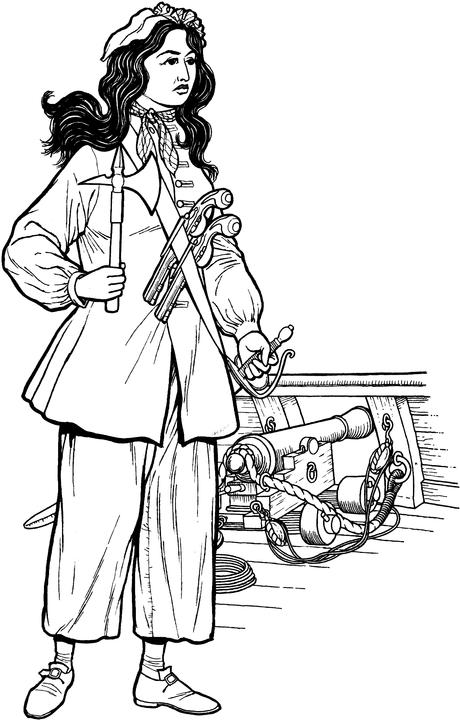
Ann Bonney

Harriett Tubman |
|
| Back to top |
|
 |
Salty Dog
Sailing Master
Posts: 10063
192187 Gold -
more...
|
| Posted: Thu May 04, 2017 2:56 pm Post subject: |
|
|
Four lesser-known women pirates
Lady Mary Killigrew
The Killigrew family, which lived in Cornwall, had a notorious reputation for seizing ships, appropriating the cargo, and selling both to finance their lifestyle. On the first of January in 1583, the Maria docked at Arwenack Castle where Lady Killigrew entertained them. For several days the Spanish captain and others visited Penryn. On their return they discovered the Maria had disappeared.
During their absence and after a storm passed, Lady Killigrew and her servants rowed to the ship, killed those Spaniards still aboard, and absconded with the cargo. Although many believed her guilty, no proof existed that she had participated in the theft and murders.
Angry at the lack of justice, the Spaniards journeyed to London where they complained to the authorities there. When it was learned that Lady Killigrew’s son, a judge, had tampered with the investigation, she and two of her gang were arrested and stood trial. All three were sentenced to death, but Queen Elizabeth I pardoned Lady Killigrew.
Charlotte de Berry
Born in England in 1636, Charlotte de Berry fell in love with a sailor. When the Royal Navy ordered him to sea, she donned male clothes and joined him on board his ship as his brother. One version of how she became a pirate said the two fought side by side in six major battles. An officer discovered Charlotte’s ruse, but said nothing because he wanted her for himself. When his first attempt to get rid of her lover failed, the officer accused him of trying to start a mutiny. He was found guilt and flogged around the fleet, a punishment that killed him. Charlotte refused the officer’s advances, stabbed him, and fled ashore.
She became an entertainer in waterfront saloons that sailors frequented. One sea captain kidnapped her, forced her to wed him, then set sail for Africa. Charlotte convinced the crew to mutiny and turn to piracy.
Another version says that sometime after the navy ship departed England, pirates attacked it. The pirate captain discovered Charlotte’s true identity, but she engaged him in a duel and lopped off his head. The pirates rejoiced on hearing of his death, and made Charlotte their new captain. Rumors soon spread about her ferocity and cruelty. One claimed she had sewn shut one captain’s mouth. Throughout her life as a pirate she pretended to be a man.
How and when she died is uncertain, but one story claims she married a wealthy Spaniard who joined her crew. A storm sank their ship and they survived without food and water for eight days aboard a raft. The survivors decided the only way they would continue to live was if they drew lots. The loser would forfeit his life to feed the others. Charlotte’s husband was the first slain just before a merchantman rescued them. Pirates attacked that ship. Charlotte fought them off, saved her rescuers, then leapt overboard to join her dead husband.
Rachel Wall
Rachel Wall may have been the first true American woman who became a pirate. She was born in 1760 in Carlisle, Pennsylvania to devout Presbyterians. A runaway, she eloped with George Wall, a fisherman and former privateer who had served during the Revolutionary War. Soon after they arrived in Boston, Wall deserted Rachel and she earned a living as a servant. Several months later, her husband returned, showed her his plundered treasure, and convinced her to join him in his piracy.
Their modus operandi was somewhat unique amongst pirates and resembled the boy who cried wolf so many times that when he really saw a wolf, no one came. They anchored near an island during a storm. After it ended, they made the vessel appear as if she would founder, then set her adrift. When another ship was sighted, Rachel screamed for help. Once the rescuers came aboard, the pirates murdered them, stole all the valuables, and sank the ship. Those ashore just assumed the victimized ship sank during the storm.
Rachel, George, and their cohorts became quite adept at piracy. Between 1781 and 1782 they captured twelve boats, murdered twenty-four sailors, and appropriated $6,000 worth of cash and merchandise.
Trouble came in September 1782 when a storm really did batter their sloop and broke the mast. George and the other pirates were washed overboard and drowned, leaving only Rachel on board. She was soon rescued and returned to Boston where she became a maid. Seven years later Rachel was accused of robbing a woman on the streets of Boston. In spite of her innocent pleas, Rachel was found guilty of the crime. She confessed to being a pirate, but not to being a thief. Even so, she was the last woman hanged in Massachusetts.
Loi Chai-san
A petite woman, who appeared harmless, Loi Chai-san was known as the Queen of the Macao Pirates. She hunted the waters around Hong Kong in the 1920’s. She amassed a sizeable fortune through sea raiding and kidnapping. The sole account of her life and escapades came from Aleko E. Lilius, a journalist who paid Loi Chai-san $43 a day to accompany her and write about her exploits in an article entitled “I Sailed with Chinese Pirates.”
On shore she dressed in white silk and knotted her hair at the nape of her neck. When aboard one of her twelve armed junks, which she inherited from another pirate named Honcho Lo, she discarded her footwear and wore a simple uniform of jacket and trousers. Two maids always accompanied her on her raids, and they delivered any communications between Loi Chai-san and her men. She, herself, never spoke to the pirates and she forbade them entry to her cabin.
When she took captives, she sent a message to his or her relatives. If they hadn’t paid the ransom after receiving a second warning, Loi Chai-san sent them the captive’s finger or ear. If this failed to persuade them to pay the ransom, she killed her prisoner.
What became of Loi Chai-san remains a mystery. One account says she attacked a torpedo squadron during the Chinese-Japanese War and died. Another tale says the International Coast Guard arrested her in 1939 and sentenced her to life imprisonment. It is believed she was the model for the Dragon Lady in the comic strip, Terry and the Pirates. |
|
| Back to top |
|
|
Captain Teague
Rigger
Posts: 1176

12207 Gold -
|
| Posted: Tue May 16, 2017 2:17 am Post subject: |
|
|
The tale of Charlotte de Berry sounds like a sea shanty; "William Taylor". Very interesting.
_________________
The Code is the Law. |
|
| Back to top |
|
|
|
|
You cannot post new topics in this forum
You cannot reply to topics in this forum
You cannot edit your posts in this forum
You cannot delete your posts in this forum
You cannot vote in polls in this forum
|
Powered by phpBB © 2001, 2005 phpBB Group |
|


