
Thomas Davis
| View previous topic :: View next topic |
| Author |
Message |
Salty Dog
Sailing Master
Posts: 10063

192187 Gold -
         more... |
 Posted: Mon Aug 28, 2017 2:03 pm Post subject: Thomas Davis |
 |
|
Thomas Davis - Reluctant Carpenter to the Pirates
In the age of wooden sail, there were no weather services, no daily forecasts, and no satellite imagery to predict the track of an incoming storm. When bad weather came along, sailors had to rely on their knowledge and experience to understand what sort of weather was coming and how to survive it.
In April 1717, a group of pirates under the command of Samuel Bellamy either ignored or failed to correctly read these signs, and were shipwrecked off the coast of Cape Cod, Massachusetts.
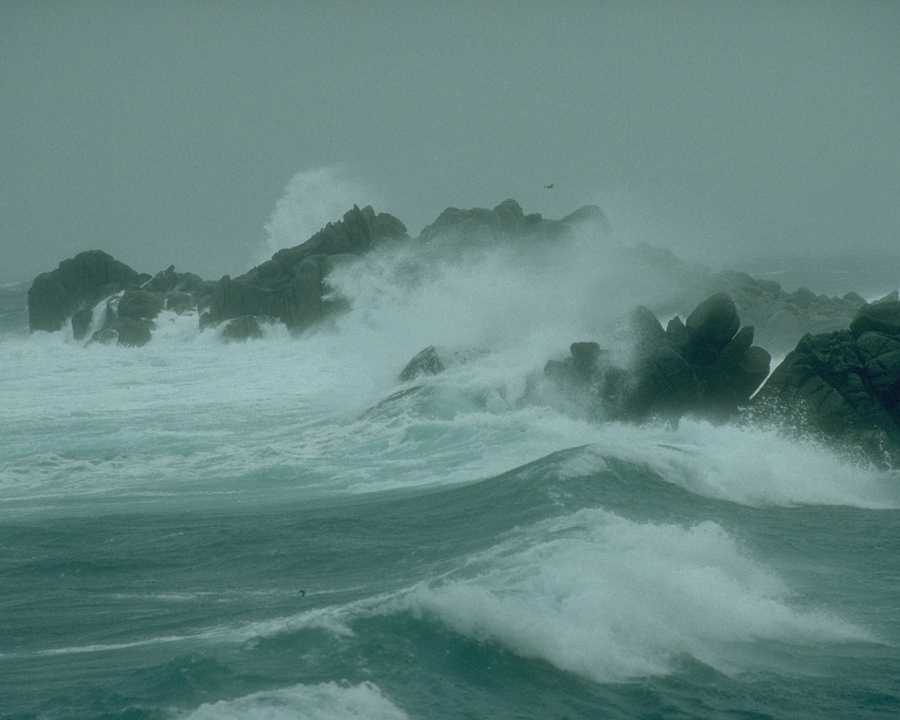
Only two men are known to have survived the wreck of the Whydah Galley: John Julian, a pilot, and Thomas Davis, a carpenter. Before the year was over, Davis would be captured, tried as a pirate, and set free.
At the time of his trial in October of 1717, Davis testified that he “was born in Carmarthenshire in Wales, Aged Two & twenty Years, is by Trade a Shipwright, and has used the Sea these five Years.” (Trials, 318)1 He was serving on a merchant ship called the St. Michael, commanded by Master James Williams. The St. Michael had sailed out of Bristol, England in September of 1716 bound for Jamaica.
In December, the St. Michael was taken by two pirate sloops, the Sultana commanded by Bellamy, and the Postillion, commanded by Louis Lebous.2 Bellamy and Lebous forced Williams to sail the St. Michael to the island of Blanco. There they were forced to stay until 9 January, “when he and fourteen other prisoners were taken aboard the Sultan Galley, then under the said Bellamy’s command who had taken her from Capt. John Richards.” (Trials, 314)
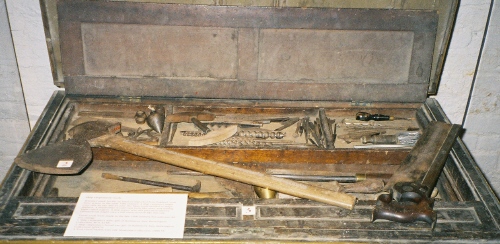
To become a ship’s carpenter in this day, a young man “always served an apprenticeship” on land to a shipwright. (Davis, 120) After a year or two in the shipyard, the apprentice would be sent to sea as a carpenter’s mate. Here he would serve out the remainder of his training, which could last up to seven years, earning “a useful sum for his master.”(Davis, 120)3
 |
|
| Back to top |
|
 |
Salty Dog
Sailing Master
Posts: 10063
192187 Gold -
more...
|
| Posted: Mon Aug 28, 2017 2:04 pm Post subject: |
|
|
Upon completion of his apprenticeship, the carpenter was qualified to work on land or sea. His duties encompassed the maintenance of the entire ship. Weather and simple daily usage took a toll on wooden ships, so the carpenter “was always working.” (Selinger, 158) They were also responsible for keeping the ship’s hull and masts sound. When the ship was taken into a port or beached for careening (cleaning), the carpenter supervised any repairs.
On a pirate ship, where surgeons were usually scarce, the carpenter’s responsibilities often included performing amputations simply because he had a saw. He would also be called upon to inspect captured ships to determine seaworthiness.
From the time he was captured by Bellamy, Davis pleaded with him to be released. Bellamy initially promised Davis he would let him go as soon as they captured another vessel. Davis would ask each time another ship was taken until Bellamy finally told him that if the company was willing, he could go. So Bellamy put the question to the company, “[w]ho expressed themselves in a Violent manner, saying, No, damn him, they would first shoot him or whip him to Death at the Mast.”( Trials, 312-313)
At Davis’s trial for piracy, witness Oliver Noyes, Esq., testified that he overheard Captain Richards tell how Davis was “desirous to be released & cryed, giving out that he was undone by being detained among them. And one of the Pirates hearing him lament his sad condition, said, Damn him, He was a Presbyterian Dog, and should fight for King James.” (Trials, 314)
Leaving the Isle of Blanco, the pirates sailed to Spanish Town on St. Croix, briefly stopping to trade and take on some new crewmembers. Toward the end of February 1717, while sailing back towards the Windward Passage, they spied a ship in the distance. Bellamy gave the order to give chase.
It took three days to catch up to the Whydah Galley. In the end, the capture was a bit anticlimactic. While the Whydah did fire her chase guns at one point, the pursuit really came down to the pirates firing a shot across her bow and Captain Lawrence Prince surrendering without a fight. Part of the reason for Prince’s easy surrender was that during this period of time, ship captains had learned that if they gave up when chased and complied with the pirates’ orders, they could avoid being tortured or shot.
Luckily for Prince, Bellamy was not known for “doing violence” to his prisoners. (Dethlefsen, 26) He ultimately traded ships with Prince, letting him sail away in the Sultana while he took possession of the Whydah. He gave Prince about “Twenty Pounds in Silver and Gold to bear his charges.” (Trials, 317) Bellamy forced eight or ten of Prince’s men, including his boatswain, to join pirates. Several others voluntarily joined their crew. At the time they encountered the storm that would seal their fate, they were headed towards Green Island, Maine with the intention of careening their ships. |
|
| Back to top |
|
|
Salty Dog
Sailing Master
Posts: 10063
192187 Gold -
more...
|
| Posted: Mon Aug 28, 2017 2:07 pm Post subject: |
|
|
The twenty-sixth of April in 1717 started out like any other day for the pirates. In the morning, they captured the Mary Anne, “a pink with more than 7,000 gallons of Madeira wine on board . . . and the Fisher – a small sloop with a cargo of deer hides and tobacco –” in the afternoon. (Clifford & Kinkor, 130) Per customary pirate procedure, smaller groups of pirates were sent over to these ships from the Whydah to act as the new crews of their “prizes.”
At the time of the wreck, the Whydah boasted a complement of about 150 men, all crammed into a ship that measured thirty feet wide and one hundred feet long. With the bulk of the pirates’ booty stored on her, the decks were probably starting to sag from such items as “[e]lephant tusks, sugar, molasses, rum, cloth, quinine, bark, indigo, and tons of dry goods.” (Clifford, 260)4 The ship also carried “precious metal, 180 sacks of coins, each sack weighing fifty pounds.” (Clifford, 260) What this meant was the Whydah would have been riding very low in the water, a dangerous condition in a storm.
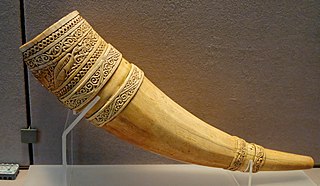

Examples of cargo such as that found by Bellamy aboard Whydah
Top: 11th-century carved elephant tusk (Source: Wikipedia); Bottom: Cargo in colonial Salem, Massachusetts |
|
| Back to top |
|
|
Salty Dog
Sailing Master
Posts: 10063
192187 Gold -
more...
|
| Posted: Mon Aug 28, 2017 2:08 pm Post subject: |
|
|
Throughout the afternoon a dense fog rolled in, which should have been an early storm warning for the pirates. Bellamy initially tried to rely on the crew of the captured Fisher to guide them through the fog. Then around five o’clock Richard Noland, commanding Bellamy’s consort ship the Marianne, came up to the Whydah to say that land had been spotted. Bellamy ordered everyone to steer north, staying close to land rather than heading out to sea.
As darkness came on Bellamy ordered all three ships to light lanterns on their sterns, a common navigational aid to help keep the ships together. But conditions continued to get worse.
An arctic storm from Canada was driving into the warm air that had swept up the coast from the Caribbean. The last gasp of a frigid New England winter, the cold front was about to combine with the warm front in one of the worst storms ever to hit the Cape. (Clifford, 262)
“According to eyewitness accounts, gusts topped 70 miles [113 kilometers] an hour and the seas rose to 30 feet [9 meters].” (Donovan)
Square-rigged ships like the Whydah Galley did not handle well in high winds, and since the winds were coming from the northeast, it was now pretty much out of the question for Bellamy to even try to attempt to head back out to sea. With each swell, the ship would have been pushed west by the winds, no matter how hard the pirates tried to keep heading north. “‘Breakers! Breakers!’ shouted a lookout at the rail who could hear, but not see, the crashing waves.” (Clifford, 264) But it was simply too late.
The accident was succinctly described by Davis in his deposition before his trial for piracy.
The Ship being at an Anchor, they cut their Cables and ran a shoar, in a quarter of an hour after the Ship struck, the Main-mast was carried by the board, and in the Morning She was beat to pieces. About Sixteen Prisoners drown’d, Crumpstey Master of the Pink being one, and One hundred and forty-four in all. (Trials, 318)
“Although the beach was just 500 feet away, the bitter ocean temperatures were cold enough to kill the strongest swimmer within minutes. Other crew members were crushed by the weight of falling rigging, cannon, and cargo as the ship, her treasure, and the remaining men on board plunged to the ocean floor, swallowed up by the shifting sands of the cape.” (Clifford & Kinkor, 131) Yet Davis and John Julian made it to shore. After climbing the seventy-foot cliffs on the beach, Davis eventually found his way to Samuel Harding’s house, which was two miles from the wreck site. Harding later said that he and Davis then made several trips on horseback to and from the wreck. |
|
| Back to top |
|
|
Salty Dog
Sailing Master
Posts: 10063
192187 Gold -
more...
|
| Posted: Mon Aug 28, 2017 2:09 pm Post subject: |
|
|
By ten o’clock in the morning, ten more men had shown up at the site. By the time Joseph Doane, Esquire arrived on Sunday morning, Cyprian Southack would report to Governor Shute that anything of value was gone.5 When asked later about what they had found, Harding claimed that Davis “gave him orders to deliver nothing of the Riches they has saved out of the Wreck.” (“Cyprian,” 8 May 1717)6

Doane would write to the lieutenant governor of how he had heard that a number of men had come ashore after a shipwreck “on the backside of the Town of Eastham the night before who were suspected to be pirates and had that Morning passed through Town inquiring the way to Rhoad Island.” (“Letter of Joseph Doane”) Since Doane was a justice of the peace, he and a deputy sheriff “pursu’d, overtook, seized, examined & committed Seven of the Pirates.” (“Letter of Joseph Doane”) Two days later, he arrested Davis.
In a letter to the governor on 28 April, Colonel Buffet told how on 26 April, the pirates had captured the Mary Anne, helped themselves to the liquor on board, and then fallen asleep. The master of the Mary Anne ran her ashore “on the back side of Eastham.” (Dethlefsen, 135) Gathering the pirates from the Mary Anne, Davis, and John Julian into one group, they took them by horseback under guard to Boston Gaol.7
Come October, when their trials were held in Boston, Governor Shute ordered Doane to be present. Doane later petitioned Shute for reimbursement of the one hundred miles he had to travel to Boston and for the ten days he was away from home.
While in gaol waiting for his trial, Davis petitioned Governor Shute to be moved to a different location than the other men. "[T]he Pyrates in Prison suspect that he will make such discovery as will not be pleasing to them, he is fearful least they should hurt him, if not deprive him of life, to prevent his Testimony against them." ("Memorial") He also said he was forced against his will to join the pirates and it caused him "great grief and sorrow." ("Memorial") Nor was he active amongst them any more than he absolutely had to. He told everything he knew when he was apprehended, but since he was a stranger, no one believed him, and he was put in chains and taken to gaol alongside the others. He also claimed to be ignorant of the charges against him that said he had made several trips to the shipwreck site and that, as a result, he knew where the treasure was and had even concealed some of it.
To be continued . . . |
|
| Back to top |
|
|
|
|
You cannot post new topics in this forum
You cannot reply to topics in this forum
You cannot edit your posts in this forum
You cannot delete your posts in this forum
You cannot vote in polls in this forum
|
Powered by phpBB © 2001, 2005 phpBB Group |
|


