
Captain Blood - The History Behind the Novel
| View previous topic :: View next topic |
| Author |
Message |
Salty Dog
Sailing Master
Posts: 10063

192187 Gold -
         more... |
 Posted: Fri Dec 08, 2017 7:17 am Post subject: |
 |
|

Earlier, Sabatini made reference to where and how Blood came to his skill as a tactician: “It was not for nothing that he had served under de Ruyter.” (Sabatini, 86) This Dutchman did exist. Michiel Adriaenszoon de Ruyter went to sea sometime between the ages of nine and eleven. Born in 1607, he became a ship’s master (captain on a merchantman) in 1635. The Zeeland Admiralty approached him to command the Haze, a warship mounting twenty-six guns, to fight the Spanish for a time, then he returned to the merchant fleet. He spent ten years scuffling with Barbary corsairs, and also freed Christian galley slaves by paying their ransom. When the First Anglo-Dutch War started, he reenlisted in the navy and became a vice admiral. He waged war in the Caribbean against the English, but during a two-hour battle with English ships in Carlisle Bay at Barbados, his flagship was heavily damaged. During the Second Anglo-Dutch War, he boldly sailed up the river Medway and destroyed several Royal Navy ships at the Chatham Dockyard. In 1676 he participated in the Battle of Augusta at Sicily against the French and was mortally wounded. Much admired, even by his enemies – Louis XIV ordered his gunners to fire salutes as the vessel carrying de Ruyter’s body sailed home along the French coast – Lieutenant Admiral General de Ruyter was a modest man who found comfort and inspiration in reading the Bible. A charismatic and brave man with keen tactical insight, he regularly conferred with his officers before implementing a course of action. He once observed, “One can not prepare everything; at sea so much unexpected may happen, that it is possible neither to put it all on paper nor to observe it timely.” (Bruijn, 451)
It was under this admiral’s tutelage that Peter Blood learns the art of war, as well as seamanship. His intent is to sail for Curaçao, but one skill Peter lacks is navigation. With Jeremiah Pitt out of commission from the severe lashing he received at Bishop’s hands, Peter offers Don Diego a chance to live if he gets them to the Dutch colony. The Spaniard agrees, but sets them on a course that will cross the path of the Lord Admiral of Castile’s flagship. This man is his brother, and Don Diego is certain Miguel will quickly end the pirates’ lives. Peter learns of the deception and has the Spaniard trussed to the open end of a gun.
One of the prisoners kept in the ship’s roundhouse is Don Diego’s son, and Peter offers the lad a choice: accompany Peter to visit with Don Miguel and convince his uncle that all is well, or his father will die when the first shot is fired to defend themselves. Don Esteban chooses the former, and with six other prisoners rowing the boat, Peter and Don Esteban board the Encarnacion with two chests laden with 50,000 pieces of eight. Deception is one tactic pirates used to snare their victims or to escape capture, and Peter plays the part well, convincing everyone aboard that he is a liberated captive returning to Spain.
Among those who greet him as Don Pedro Sangre (Spanish for Peter Blood), is “a friar in the black and white habit of St. Dominic.” (Sabatini, 113) Saint Dominic de Guzman of Spain had founded the Dominican Order in the Middle Ages. Spain defended the Catholic faith, so a regular member of a vessel’s crew was a priest, who was charged with protecting the souls of all those aboard.
Peter soon returns to the frigate, where Don Esteban learns his father had succumbed from fear prior to their departure for the Encarnacion. He warns Peter that one day he will hang from the yardarm, which makes some of his fellow pirates want to string up Esteban and the other Spaniards. Peter, however, sways the council to put their captives over the side in a boat and sail for Tortuga, the haven of the buccaneers. |
|
| Back to top |
|
 |
Salty Dog
Sailing Master
Posts: 10063
192187 Gold -
more...
|
| Posted: Fri Dec 08, 2017 7:17 am Post subject: |
|
|
Part 5: Tortuga, Levasseur, and Maracaibo
At this juncture in Peter Blood’s story, the narrator tells the reader of Pitt’s logs. He also confesses he believes “Esquemeling…must have obtained access to these records, and that he plucked from them the brilliant feathers of several exploits to stick them into the tale of his own hero, Captain Morgan. …I mention it chiefly as a warning, for when presently I come to relate the affair of Maracaybo, those of you who have read Esquemeling may be in danger of supposing that Henry Morgan really performed those things which are veraciously attributed to Peter Blood.” (Sabatini, 121)
John Esquemeling is the name under which Alexandre Exquemelin’s book Buccaneers of America was published in English. This tome recounts the exploits of Morgan and other buccaneers, including Exquemelin, as well as pirate life. Whether Morgan would agree that he’s the hero of the book is a matter of perspective. He sued several publishers for libel and won.
The safe haven for French and English pirates in Peter Blood’s time was Tortuga. Exquemelin said of it:
Tortuga lies on the north side of the great and renowned island of Hispaniola, about three leagues from the coast, 20° 30’ north. The small island is some sixteen leagues in circumference, and acquired its name because its shape is like a turtle, which the Spanish call ‘tortuga.’ …People live only on the south side, and here there is but one harbour which ships can enter. (Exquemelin, 29)
This is the “home” of the Brethren of the Coast, and much of what we know of them comes from Exquemelin. Once Peter and his company officially go on the account, they draw up articles under which they will sail.
Aboard the Arabella there was to be none of the ruffianly indiscipline that normally prevailed in buccaneering vessels. Those who shipped with him undertook obedience and submission in all things to himself and to the officers appointed by election. (Sabatini, 122)
This differs from the historical agreement or chasse partie that Exquemelin describes.
…in which is specified what the captain shall have for himself and for the use of his vessel. …Providing they capture a prize, first of all these amounts would be deducted from the whole capital. The hunter’s pay would generally be 200 pieces of eight. The carpenter, for his work in repairing and fitting out the ship, would be paid 100 or 150 pieces of eight. The surgeon would receive 200 or 250 for his medical supplies….
Then came the agreed awards for the wounded, who might have lost a limb or suffered other injuries…for the loss of a right arm, 600 pieces of eight or six slaves; for a left arm, 500 pieces of eight or five slaves…; a left leg, 400 or four slaves; an eye, 100 or one slave, and the same award was made for the loss of a finger….
These amounts having first been withdrawn from the capital, the rest of the prize would be divided…. The captain draws four or five men’s portions for the use of his ship…and two portions for himself. The rest of the men share uniformly, and the boys get half a man’s share.
When a ship has been captured, the men decide whether the captain should keep it or not…. When a ship is robbed, nobody must plunder and keep his loot to himself…. To prevent deceit, before the booty is distributed everyone has to swear an oath on the Bible that he has not kept for himself so much as the value of a sixpence…. And should any man be found to have made a false oath, he would be banished from the rovers…. (Exquemelin, 71-2)
Sometimes the buccaneers sailed in fleets, and one captain approaches Blood with such a proposal. His name is Levasseur, whom Sabatini describes as “…tall and built on lines of agile strength, with a swarthy, aquiline face that was brutally handsome…. A roaring, quarrelsome, hard-drinking, hard-gaming scoundrel, his reputation as a buccaneer stood high among the wild Brethren of the Coast. He enjoyed also a reputation of another sort. There was about his gaudy, swaggering raffishness something that the women found singularly alluring.” (Sabatini, 124-5) |
|
| Back to top |
|
|
Salty Dog
Sailing Master
Posts: 10063
192187 Gold -
more...
|
| Posted: Fri Dec 08, 2017 7:18 am Post subject: |
|
|
Did Levasseur actually exist? Not this particular one, but the name is familiar to any who study pirates. Jean le Vasseur arrived in Tortuga in 1642 to serve as governor. He was of Norman extraction and a Huguenot (Protestant) who had fled France. A military engineer by trade, he constructed a formidable stronghold on a rocky outcrop overlooking the harbor. Armed with twenty-four cannon, Fort de Rocher successfully defended the buccaneer haven against Spanish incursions. Le Vasseur also erected a house, which he named “Dove-cote,” and the only way visitors could reach it was to climb the stairs cut into the rock then ascend iron ladders. During his twelve years as governor, he issued letters of marque and collected a share of the privateers’ booty. He also implemented numerous fees and taxes, especially on hides and tobacco. In 1653 his heirs, young men named Martin and Thibault, murdered him during a quarrel over a mistress.
But this was not the only Levasseur in pirate history. Olivier le Vasseur hunted in the Indian Ocean in the early eighteenth century. Nicknamed La Buse (The Buzzard), he often sailed in consort with two other pirates, John Taylor and Edward England. When England showed leniency toward captives, La Buse and Taylor abandoned him on Réunion Island. Among the treasures La Buse captured was the Fiery Cross of Goa, a gold cross encrusted with rubies, diamonds, and emeralds. Its weight required three men to transport the object. After being shipwrecked on the Île Sainte Marie, La Buse assumed another name and worked as a pilot until someone recognized him in 1728. Thereafter, he resumed the sweet trade until a French warship, captained by a man named L’Ermitte, captured him. Le Vasseur was convicted at St. Denis on Réunion Island and hanged on 17 July 1730. Before he danced the hempen jig, he tossed papers containing a cryptic message to the gathered crowd and dared them to find the Fiery Cross of Goa, saying, “My treasures to those who will understand!” (The treasure remains unfound.)
At the time of Peter Blood’s arrival at Tortuga, the governor is a man named d’Ogeron. Exquemelin describes Bertrand d’Ogeron, Sieur de la Bouère, as “a man of good intellect though he feigned to be a fool….” (Exquemelin, 228) The fourth to hold this position, he arrives on the island to assume his duties in 1665. He comes as the representative of the Compagnie des Indes Occidentales, or French West India Company, an organization the buccaneers detested. As a result, he wasn’t well received. In 1770 they staged a revolt to unseat him, but the Governor General of the Windward Islands sent ships and men to help d’Ogeron put down the revolt. This, combined with the amnesty the French king offered, brought the buccaneers and the governor into coexistence. During the Franco-Dutch War, Spaniards captured and imprisoned him on Hispaniola for several months before he escaped. In 1773 he led five hundred buccaneers on a raid of Puerto Rico that ended in disaster. He eventually returned to France and died on 31 January 1776, “afflicted by an incurable diarrhea.”
That Blood and Levasseur joined forces wasn’t unusual. Many buccaneers, as well some pirates of the next century, sailed in consort. In 1669 Henry Morgan sent word for the buccaneers to gather at Cow Island off Hispaniola, with the intent to attack Cartagena. Why this particular target?
[I]t was the biggest port in Spain’s vast empire; here was collected the treasure from all of Peru. … the center of trade and culture. But it was also a fortress. After Drake and his English and French peers had ransacked the city in the late 1500s, the Spanish Crown had begun a massive building program that studded the lagoons that led to the city with castles and forts, which were now manned by 400 soldiers and fifty cannon. (Talty, 142-3)
This was why such a large force was needed, for without enough men and firepower, the pirates would face defeat.
Cartagena was a real power center on the Main, but its defenses were awesome… twice as many soldiers in its garrison as Panama and Portobelo combined, underground tunnels, fifty cannon, a large population of 6,000 free men and slaves to draw on for reinforcements.” (Talty, 203)
In all twelve ships arrived with nine hundred men, but an unfortunate explosion aboard Morgan’s flagship, the Oxford, killed two hundred men. Morgan was one of the lucky survivors, but he no longer possessed a sufficient force to strike Cartagena. They chose Maracaibo as their target, but they weren’t the first buccaneers to attack that place.
When L’Olonnais decided to strike Maracaibo, he did so with 660 buccaneers in eight ships. En route, they took a Spanish prize laden with 40,000 pieces of eight, jewels, and a rich cargo of cacao. Sabatini’s Levasseur was one of the men who followed L’Olonnais, but who was this infamous buccaneer cruelty knew few bounds? |
|
| Back to top |
|
|
Salty Dog
Sailing Master
Posts: 10063
192187 Gold -
more...
|
| Posted: Fri Dec 08, 2017 7:19 am Post subject: |
|
|
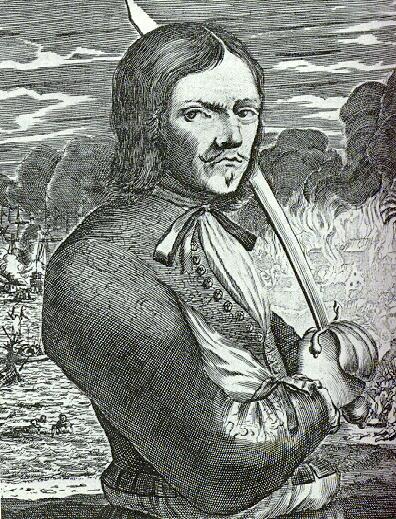
Born Jean David Nau in Olonne, France, he arrived at Saint-Dominigue as an engagé, or indentured servant. He eventually became a buccaneer in the 1660s, and as was true of many of his comrades, he had a deep hatred for Spaniards and showed them little mercy. After taking one Spanish ship, L’Olonnais imprisoned the seamen belowdecks. Then he directed his men to “let them come up one after the other, and as they came through the hatch, struck off their heads. When he had finished off a number of them, there came the turn of the Negro who was to have been the rovers’ executioner.” (Exquemelin, 91) L’Olonnais spared his life, but sent him to tell Havana’s governor that no quarter would be shown toward any Spaniard L’Olonnais and his men captured.
He remained true to his word. Exquemelin wrote, “When l’Olonnais had a victim on the rack, if the wretch did not instantly answer his questions he would hack the man to pieces with his cutlass and lick the blood from the blade with his tongue. . . .” Another time he “. . . ripped open one of the prisoners with his cutlass, tore the living heart out of his body, gnawed at it, and then hurled it in the face of one of the others, saying, ‘Show me another way, or I will do the same to you.’” (Exquemelin, 106 and 107) In the end, l’Olonnais met an equally gruesome, but perhaps fitting, death.
On arrival in the Gulf of Darien, he and his men fell into the hands of those savages the Spaniards called Indios Bravos. According to one of his companions, who only saved himself from a like fate by running away, l’Olonnais was hacked to pieces and roasted limb by limb. (Exquemelin, 117)
Levasseur shows an equally cruel streak, but Blood “could not deny that the fellow’s proposals displayed boldness, imagination, and resource…” – all essential traits of a successful pirate captain. (Sabatini, 125) Peter soon comes to regret his agreement to join with Levasseur, something he only does at the behest of his men. The first ship they attack is a Dutch brig, although Peter does so only to prevent Levasseur from wreaking violence. They become separated during the night, but when they meet up again on the coast of La Virgen Magra, Blood has acquired a second ship laden with “a hundred and twenty thousand weight of cacao, forty thousand pieces of eight, and the value of ten thousand more in jewels.” This treasure is reminiscent of what L’Olonnais acquired on his way to raid Maracaibo. All were common aboard Spanish vessels, for the wealth of the Spanish Main was transported to the mother country to fill the king’s coffers. The English referred to the peso de ocho reales as a piece of eight, a silver coin minted in large quantities in Mexico City and Lima, Peru. This translation comes from the fact that the peso could be divided into eight sections to make change. It was so widely circulated it was accepted throughout English colonies and was equivalent to four and a half shillings.
Once again the two pirate captains separate, which is when Levasseur decides to ransom the captives he had concealed from Blood. In a confrontation with one, he threatens to use the “rosary of pain.”
His fingers had been busy tying knots in a length of whipcord. …He flung the length of knotted cord to one of the Negroes, who in an instant made it fast about the prisoner’s brows. Then between cord and cranium the black inserted a short length of metal, round and slender as a pipe-stem. (Sabatini, 138)
Pirates used this simple device to inflict pain because the tools were readily at hand. Once the cord was wrapped around a person’s head, the torturer inserted a stick or other long, thin object at the back of the head, then twisted it to tighten the cord. If the victim opted to keep silent, the rosary could cause his eyes to “burst out the skull.” (Cordingly, 131) This technique was called “woodling.”
In chapter sixteen, Blood and his men, in consort with those who had followed Levasseur until his death on Peter’s sword, decide to raid Maracaibo in August 1687. Exquemlin described the region thusly:
[Maracaibo] bay lies on the mainland coast of New Venezuela, about latitude 12° north; it is some twenty leagues deep and twelve leagues across. To seaward of the bay lie the islands of Onega and Monges; the eastern headland of the bay is called Cabo San Roman, and the westerm Cabo Coquibacoa. This bay generally goes by the name of the Gulf of Venezuela, but the buccaneers call it Maracaibo Bay.
In the strait giving access to the interior part of the bay are two islets. The easterly one is called Isla de la Vigia, or Lookout Island, because on a high hill in the middle stands a watchtower, with a sentinel on duty day and night. The other is called Isla de las Palomas, or Pigeon Island. Beyond these islets, deeper inland, is a lake of sweet water, sixty leagues by thirty. This lake flows through the strait into the Gulf of Venezuela and the open sea. The entrance for shipping between the two islets is no wider than the range of an eight-pounder. On Pigeon Island stands a fort guarding the strait, as any ship wishing to enter the lake must pass close to the island. For at the mouth is a bar, or sandbank, in fourteen feet of water, and about a league inwards is another sandbank called El Tablazo, where there is only ten feet of water. Thereafter, as far as Rio de las Espinas (about forty leagues along the lake) the water is six, seven and eight fathoms deep.
“Some six leagues along the lake shore, on the western side, lies Maracaibo, a very handsome city with fine-looking houses along the waterfront…on the other side of the lake, some thirty leagues south of Maracaibo… a big village called Gibraltar.” (94-5, Exquemelin) |
|
| Back to top |
|
|
Salty Dog
Sailing Master
Posts: 10063
192187 Gold -
more...
|
| Posted: Fri Dec 08, 2017 7:20 am Post subject: |
|
|
Twenty years before Blood’s raid, L’Olonnais attacked both cities after quickly subduing the battery “of sixteen cannon surrounded by several gabions or earth-filled wicker cylinders, with a ramp of earth thrown against them to shelter the men inside” that guarded the guarded the entrance to the lake. (Marley, 287) L’Olonnais and his men proceeded to Maracaibo, but the citizenry had fled the city. Not finding the booty they desired, the invaders crossed the lake to Gibraltar where they fought a heated battle with Spanish soldiers. This city, too, fell, but with heavy losses. Forty pirates died and another thirty were wounded, but these losses were minimal compared to the hundreds of Spaniards who succumbed. The buccaneers heaved the dead into two boats, towed them a mile from shore, then sank the boats. Afterward, they ransacked Gibraltar for a month. L’Olonnais warned the people that if they failed to pay him a ransom of 10,000 pesos, he would torch the city. Once the buccaneers pocketed that hefty sum, they returned to Maracaibo and demanded another 20,000 pesos plus five hundred cattle.
After the explosion that destroyed the Oxford in 1669, Henry Morgan and the remaining buccaneers decided to attack Maracaibo. The fort on Lookout Island was far different from the one L’Olonnais had attacked. “The Spaniards had built a new fort, from which they welcomed Morgan with the heavy artillery they had installed.” (Exquemelin, 146) Even so, the soldiers decided to abandon the fort, but left behind them a surprise.
The Spaniards too were busy with their preparations at the fort. They burned down several near-by houses to give them a clear field of fire, and kept up a heavy cannonade all day long.
It was dusk when Morgan and his men reached the fort. They found nobody inside, for when they saw the buccaneers close by the walls the Spaniards had let off some gunpowder and made for the woods under cover of the smoke. …They found a cellar full of gunpowder, much of it scattered about – and a length of burning match about an inch away from the powder, so that the buccaneers narrowly missed being blown up with the fort and all. (Exquemelin, 146)
As happened to his predecessor, Morgan found Maracaibo abandoned. The pirates went in search of the townspeople and “returned next evening with about fifty mules laden with various goods, and thirty prisoners…. The prisoners were promptly tortured in the usual manner to make them say where the fugitive citizens were hiding. One was strappado’d and beaten, another was spread-eagled with burning fuses between his fingers and toes, another had a cord twisted so tight round his head his eyes protruded like eggs. If they still would not tell they were put to death, when there were no further torments that could be inflicted on them.” (Exquemelin,147)
Morgan and his men also attacked Gibraltar, but when they returned to Maracaibo, an informant told them “three Spanish men-of-war in the mouth of the lake, lying in wait for him, and the fort had again been well equipped with artillery and soldiers.” (Exquemelin, 153)
The warships were full of troops, and the biggest carried at least forty guns, the next thirty, and the smallest twenty-four. The fort also was well defended.
These forces were disproportionately greater than Morgan’s, for his heaviest ship only carried fourteen guns. (Exquemlein, 153)
Rather than quake with fear, Morgan exchanged several messages with the Spanish commander, Don Alonzo del Campo y Espinosa. The pirates refused to submit peacefully and decided to use a fire ship to destroy the enemy ships.
They collected all the tar, pitch, brimstone and other combustibles that could be found in the city...filled the hold with palm leaves dipped in a mixture of pitch, tar and brimstone, covered the counterfeit cannon on deck with the same stuff and laid six pots of gunpowder under each, and sawed up half the woodwork inside the ship so that it could blow up and burn with greater force. They also made new portholes through which they stuck the long hollow logs… in place of artillery. Along the deck they set wooden props, each fitted with a cap or hat to look like a man, and then hoisted the admiral’s flag. (Exquemelin,155-6)
The buccaneers managed to sail the fire ship close enough to tie her to the enemy ship, and despite a valiant effort by the Spanish, the general and his men were forced to abandon their vessel. This act only made the Spaniards more determined to capture Morgan and his men, while the crafty buccaneer devised another plan to thwart them and make his escape.
Many of the men embarked in canoes, as if intending to land, and came ashore under the shelter of the trees. But most of them in fact lay flat on their bellies at the bottom of the canoes and so returned to the ships, without more than three or four men being visible on the return journey. Various trips like this were made from all the ships, so that the Spaniards became convinced the rovers intended a night attack on the fort with scaling-ladders. In consequence, they made great preparations for defending the fort from the landward side, bringing all the artillery to bear in that direction.
Night came, and the moon shone bright. The buccaneers…slipped anchor and let the ships drift with the tide until they came level with the fort – then they clapped on all sail and sped with the land wind behind them beyond the bar…. (Exquemelin,162)
In Captain Blood, Peter faces his nemesis Don Miguel de Espinosa. He uses both of Morgan’s ploys to effect his escape. Sabatini’s narrator says this of Blood’s attack on Maracaibo: “The affair…is to be considered as Captain Blood’s buccaneering masterpiece. …his genius for naval tactics…. The fame which he had enjoyed before this, great as it already was, is dwarfed into insignificance by the fame that followed. It was a fame such as no buccaneer – not even Morgan – has ever boasted, before or since.” (Sabatini, 175) |
|
| Back to top |
|
|
Salty Dog
Sailing Master
Posts: 10063
192187 Gold -
more...
|
| Posted: Fri Dec 08, 2017 7:21 am Post subject: |
|
|
Part 6: Cartagena, Port Royal, and War

In 1494 Pope Alexander VI divided the New World between Spain and Portugal in a document known as the Treaty of Tordesillas. Rumors of the wealth of this new region spread throughout Europe, but a French privateer named Jean Fleury exposed the truth behind the rumors in 1523. France and Spain were at war, and that year he encountered three Spanish carvels off the coast of Portugal. Although one vessel escaped, he subdued the other two. When the corsairs checked the ships’ holds, they uncovered golden “Aztec statues and religious artefacts...exquisite jewellery…an emerald the size of a fist, discs and ingots of gold and silver, bejeweled cloaks and headdresses…even a live jaguar.” (Konstam, 2008)
Such riches led other European countries to claim lands in the New World, but the navies of these countries were unable to defend those territories. The Caribbean governors licensed the buccaneers to protect their islands against Spain. In times of peace, though, these privateers continued their raids. This often led to problems back home, especially if the English monarch wished to placate Spain. Such was the case when Charles II demanded Henry Morgan’s arrest and return to London. The buccaneer arrived there in 1672, but once again political factions shifted and he soon found himself appointed Lieutenant-Governor of Jamaica.
The sands of time, however, were slowly passing and with this passage went people’s tolerance for the buccaneers. Sir Thomas Lynch, the Jamaican governor who had arrested Morgan, wrote:
People have not married, built, or settled as they would in peace; some for fear of being destroyed, others have got much and suddenly by privateers’ bargains are gone. War carries away all freemen, labourers, and planters of provisions, which makes work and victuals dear and scarce. Privateering encourages all manner of disorder and dissoluteness, and if it succeed, does but enrich the worst sort of people, and provoke and alarm the Spaniards, constraining them to arm and fortify…. (Talty, 262-3)
At this point, privateers were both cursed and touted as heroes, but almost two decades later things were not nearly so clear cut. England and Spain were once again at peace, and James II issued “A Royal Proclamation for the more effectual reducing and suppressing of Pirates and Privateers in America” in January 1688. It no longer mattered whether a buccaneer had a commission or not; he was an outlaw who should be brought to justice.
To that end, Colonel Bishop is appointed Lieutenant-Governor of Jamaica. (In actuality two other gentlemen serve in that position in 1688: Christopher Monck, Duke of Albemarle, and Hender Molesworth.) While Bishop makes inroads in suppressing piracy, one pirate continues to elude him – Peter Blood. Lord Sunderland, England’s Secretary of State, decides to use another means to turn this buccaneer away from the sweet trade.
He turned to the consideration of extraordinary [means], and bethought him of the plan adopted with Morgan, who had been enlisted into the King’s service under Charles II. …His lordship did not omit the consideration that Blood’s present outlawry might well have been undertaken not from inclination, but under stress of sheer necessity; that he had been forced into it by the circumstances of his transportation, and that he would welcome the opportunity of emerging from it. (Sabatini, 178)
After Peter Blood rescues Arabella Bishop and Lord Julian Wade from the hands of Don Miguel, Wade offers Blood James’ commission. To which Peter replies:
…I’ll not be telling you what I think of you for daring to bring me this offer, or of my Lord Sunderland…for having the impudence to send it. But it does not surprise me at all that one who is a minister of James Stuart’s should conceive that every man is to be seduced by bribes into betraying those who trust him. …Are there not even notions of honour left in England? …D’ye think I could take a commission of King James’s? I tell you I wouldn’t be soiling my hands with it – thief and pirate’s hands though they be. Thief and pirate is what you heard Miss Bishop call me to-day – a thing of scorn, an outcast. And who made me that? Who made me thief and pirate? (Sabatini, 207)
Regardless of his thoughts on the matter, or his eventual acceptance of the commission, Peter gives the order for the Arabella to put in at Port Royal’s harbor.
Between 1655 and 1692 Port Royal was the fastest growing town within England’s colonies. Unlike Boston, her principal rival, this port’s citizenry incorporated people from all walks of life and diverse religions. The buccaneers found Port Royal appealing because of its close proximity to trade routes that allowed them easy access to prey. The large harbor accommodated their ships and provided them a place to careen and repair these vessels. Port Royal was also ideally situated for launching raids on Spanish settlements. By the 1660s, the town had gained a reputation as “the Sodom of the New World.” When Charles Leslie wrote his history of Jamaica, he included this description of the pirates of Port Royal.
Wine and women drained their wealth to such a degree that…some of them became reduced to beggary. They have been known to spend 2 or 3,000 pieces of eight in one night; and one gave a strumpet 500 to see her naked. They used to buy a pipe of wine, place it in the street, and oblige everyone that passed to drink.” |
|
| Back to top |
|
|
Salty Dog
Sailing Master
Posts: 10063
192187 Gold -
more...
|
| Posted: Fri Dec 08, 2017 7:22 am Post subject: |
|
|
Port Royal grew to be one of the two largest towns and the most economically important port in the English colonies. At the height of its popularity, the city had one drinking house for every ten residents. In July 1661 alone, forty new licenses were granted to taverns. During a twenty-year period that ended in 1692, nearly 6,500 people lived in Port Royal. In addition to prostitutes and buccaneers, there were four goldsmiths, forty-four tavern keepers, and a variety of artisans and merchants who lived in two hundred buildings crammed into fifty-one acres of real estate. Two hundred thirteen ships visited the seaport in 1688.
Colonel Bishop does manage to arrest Peter Blood, but not for piracy. Since he possesses the king’s commission and he permitted Wolverstone and others to depart Port Royal, the lieutenant-governor will court-martial Blood. This buccaneer eventually escapes, taking Bishop as hostage until the Arabella is safely beyond the reach of the fort’s cannons.

At this point, the situation in Europe once again intrudes. Louis XIV of France, also known as the Sun King, invades German territory and captures Heidelberg. The German Elector’s ally is Spain, so that nation declares war on France. In England, Queen Mary gives birth to a son. Normally this would be cause for rejoicing, but this son, who would become known later as the Old Pretender for his attempts to regain the British thrones for the Royal House of Stuart, upset the line of succession. England and Parliament has tolerated the Catholicism of the king and queen because until 1688, James II’s heir is Mary Stuart, his older daughter by his first wife, Anne Hyde. If Mary dies, her younger sister, Anne, succeeds to the throne. Both girls have been raised in the Anglican Church by order of King Charles following his brother’s secret conversion to the Catholic faith. Now, however, James’ son will inherit the crown, which means a continuation of popish monarchs ruling England. Since the queen is fifty-two and has failed to produce an heir before this, rumors surface about the legitimacy of this baby. Unwilling to allow another Catholic king to come to power, English lords and bishops secretly invite Mary Stuart and her husband, William of Orange, to cross from the Netherlands and become Queen and King of England. This period in English history becomes known as the Glorious Revolution, a bloodless war that sees James II flee to France. Parliament confirms his abdication and proclaims William and Mary monarchs until their deaths. In 1689 Louis XIV declares war on England.
After his hasty departure from Jamaica, Peter Blood joins his comrades in Tortuga. News arrives several months later of the war between France and Spain, and Governor d’Ogeron brings a stranger aboard the Arabella to meet with Peter. This gentleman is Monsieur de Cussy, the Governor of French Hispaniola. He proposes the buccaneers join forces under Baron de Rivarol, commander of the French fleet, to wage war in the Caribbean against the Spaniards. The first objective of this combined force of buccaneers and the French Navy is Cartagena.
Pierre-Paul Tarin de Cussy was indeed Governor of Saint-Dominigue. Following the lead of those who had ruled before him, he considered the buccaneers essential for the island’s defense. The War of the League of Augsburg, also known as King William’s War pitted France against England, the Netherlands, and Spain. Two years before, in 1687, France had forced him to grant amnesty to all buccaneers “on conditions that they return into ports and cease their piratical acts and become inhabitants, or give themselves over to the business of the sea.” (Marley, 96) When war broke out, endangering the well being and safety of Saint-Domingue, he wrote, “I destroyed privateering here because the court so willed it….” Had he not done so “there would be ten or twelve stout ships on this coast, with many brave people aboard to preserve this colony and its commerce.” (Marley, 96)
While de Cussy was a real personage, Baron de Rivarol was merely a fictional character, although a French admiral did arrive in the Caribbean to lead a joint expedition of naval personnel and buccaneers against Cartagena, but not until 1696. This gentleman’s name was Bernard-Jean-Louis de Saint Jean, Baron de Pointis. He joined the navy as a midshipman in 1672. Five years later he served as a lieutenant when Admiral Comte d’Estrée attempted to capture Tobago. In 1696 the baron took command of the Sceptre, a man o’ war armed with eighty-four guns, and led a fleet of ships carrying 2,800 soldiers to the West Indies. The Crown had supplied the ships, crews, and soldiers, but bankruptcy forced de Pointis to rely on the wealth of benefactors to finance the operation and provide supplies. When he arrived at Saint-Domingue, he ordered Governor Jean-Baptiste Ducasse – de Cussy had died in battle five years earlier – to gather as many buccaneers as possible to supplement his forces.
When Peter meets Baron de Rivarol, the admiral does little to disguise his feelings toward the buccaneers. “His manner implied plainly that he despised them and that he desired them at once to understand it.” (Sabatini, 267) His real life counterpart had an equal disdain for these men. He considered them to be “the refuse of all the kingdom, without honor, without virtue.” (Marx, J., 132) Still both barons tolerated the buccaneers, for without them the mission was doomed.
In the novel, Wolverstone comes ashore “in the picturesque garb that he affected, his head swathed in a coloured handkerchief.” A French officer makes a snide comment; Wolverstone returns the favor. The Frenchman insults the buccaneer, who in turn knocks the officer senseless. When de Rivarol learns of this, he arrests Wolverstone. This incident is based on fact. When one buccaneer causes a ruckus, an officer throws the man in jail. As a result, a riot ensues and two or three people die. The mob disperses only after Governor Ducasse intervenes.
Another instance of fiction mirroring fact is Blood’s disagreement with Baron de Rivarol over the shares the buccaneers will receive once Cartagena is taken. Baron de Pointis agrees these men will receive the same amount of shares as he and his men. Once the day of departure arrives, Sabatini’s fleet consists of the admiral’s flagship, four additional French ships, the Arabella, and at least fifteen other vessels of varying sizes. De Pointis’s fleet was a similar concoction: seven ships carrying seven hundred buccaneers and thirteen royal warships.
The only man to successfully take Cartagena – or more properly, Cartagena de Indias – so far had been Sir Francis Drake in 1573. Cartagena was one of the ports of the Tierra Firme Flota. Once the treasure galleons collected Peruvian silver at Nombre de Diós, they sailed to Cartagena to collect gold, emeralds, and pearls. This was why the city was such an appealing target to the buccaneers. But the Cartagena Drake raided was not the same as the one that either the fictional French fleet or the real one attacked. Walls and bastions were erected in the seventeenth century while the forts protecting the harbor entrance were reinforced or built anew. At the time the fleets arrive, San Luis de Bocachica, a bastioned fort, guarded the southern entrance while San Felipe de Barajas, a citadel atop a hill northeast of the city, protected the northern entrance. |
|
| Back to top |
|
|
Salty Dog
Sailing Master
Posts: 10063
192187 Gold -
more...
|
| Posted: Fri Dec 08, 2017 7:22 am Post subject: |
|
|
In spite of these defenses, Baron de Pointis succeeded in capturing the city. The buccaneers suggested attacking from the land, but dangerous reefs forced the admiral to select another plan of attack. The target instead would be to attack Bocachica. Twelve hundred men captured the fort, but not without six soldiers and seven buccaneers dead and another twenty-two men wounded, including Ducasse.
Next the admiral ordered the buccaneers to take the high ground while he and the army marched overland to the city. This plan was not received well among the buccaneers, and when one man dared to stop the commander of the buccaneer contingent – Joseph d’Honon de Gallifet, Ducasse’s second in command – de Pointis ordered the man bound to a tree and blindfolded. His musketeers prepared to fire, but Gallifet intervened and the man’s life was spared. Afterward, the buccaneers took the objective as ordered, while the French army laid siege to Cartagena.
Guns from the ships bombarded the city, and four days later, on 2 May, the Spaniards raised a white flag to signal their surrender after two days of bloody battle. While terms were negotiated, word arrived that more then 1,000 Spanish soldiers were marching on Cartagena. De Pointis sent the buccaneers to thwart their attempt to relieve the city. This warning turned out to be a rumor, so the buccaneers returned to Cartagena, only to find the city’s gates closed to them. They were forced to find a place to rest and food to eat in a poor area already devastated by the fighting. De Pointis took these measures to insure his allies didn’t upset the terms of surrender he had negotiated with the Spaniards.
The total amount de Pointis and his soldiers plundered came to 8,000,000 French crowns. According to the articles under which they sailed, the buccaneers expected to receive one fourth of this, but de Pointis gave them only 40,000 crowns. That equaled the percentage his own men had earned, which was what he meant when he had agreed to share equally. He just failed to include this kernel of information at the time he “offered them shares ‘man for man’.” (Marley, 128)
Ducasse sided with the buccaneers and demanded the admiral abide by the articles. Unknown to him or his followers, the booty was no longer in Cartagena. It had been taken aboard the French warships. Once all the Frenchmen were aboard, de Pointis set sail for France. Angered at being duped, the buccaneers hunted the streets and houses until all the Spaniards were captured and taken to the church. Once inside, their captors dusted them with gunpowder and threatened to ignite it unless the citizens paid them 5,000,000 livres. They failed to raise that much, but each buccaneer received 1,000 crowns. On 3 June, they left Cartagena.
Sabatini bases de Rivarol’s and Blood’s attack on this real event. The French General of the Armies of France by Sea and Land in America reneges on the articles he had promised the buccaneers. True to character, de Rivarol and his men make a soft farewell – depart under cover of darkness – while the buccaneers are asleep. When the trickery is discovered the next morning, these fictional characters are as angry as their real counterparts, but whether they induce the Spaniards to hand over additional plunder is left to the reader’s imagination.
Peter and his men opt to go after de Rivarol, but as they pass Jamaica, they hear gunfire. They assume Port Royal fires on a ship, but soon discover the fiery remains of an English ship and boats loaded with the survivors. One is a gentleman by the name of Lord Willoughby. It is from him that Peter and his comrades learn “they’ve roused themselves at home, and kicked out that scoundrel James and his gang of ruffians.” (Sabatini, 296)
This Lord Willoughby is Governor-General of the West Indies, but he is fictional. Perhaps Sabatini chose this name for this character because there was a real Lord Willoughby associated with the Caribbean. Francis Willoughby of Parham served as Governor of Barbados during Charles II’s reign from 1650 to 1652. He successfully defended Barbados from a Dutch attack in 1665. The following year, he participated in an attack against the French on Saint Kitts, but was lost at sea. |
|
| Back to top |
|
|
Salty Dog
Sailing Master
Posts: 10063
192187 Gold -
more...
|
| Posted: Fri Dec 08, 2017 7:23 am Post subject: |
|
|

In 1689 William and Mary pardoned all the rebels whom James’s government had transported to the colonies. The fictional Lord Willoughby reveals this fact while aboard the Arabella, but since England is at war with France, perhaps Peter would prefer to serve theses monarchs since he has a wealth of knowledge about the Caribbean and their colonies need good men to protect them from intruders. When he learns Colonel Bishop has left Port Royal defenseless, Peter decides he must protect the city, which at present is under fire from the French commanded by Baron de Rivarol.
This, too, is based on fact. In June 1694 during the Nine Years’ War, Jean-Baptiste Ducasse attacked Jamaica with twenty-two ships. He and his men burned fifty sugar plantations and seized more than 1,000 slaves on the island’s southern coast before departing.
With the element of surprise to his advantage, Peter executes a daring maneuver. The Arabella and the Elizabeth, the consort that sails with him, unleash devastating broadsides as they sail past in turns. Then they come round while confusion reigns aboard the enemy ships and unleash a second broadside.
A real buccaneer executed a similar move, but whether Sabatini used this incident as the basis for Blood’s maneuver is unknown.
Novelist Rafael Sabatini admitted to appropriating Henry Morgan’s tactics for his eponymous pirate hero, Captain Blood. But in character, Peter Blood was more akin to a taciturn, sardonic Laurens de Graff, and without doubt Sabatini appropriated Laurens’s tactic of sailing between two Spanish men-of-war and engaging them simultaneously, and lent it to his hero. (216, Little, Buccaneer’s)
Laurens Cornelius Boudewijn de Graaf was a tall Dutchman with blonde hair and moustache.
He always carries violins and trumpets aboard with which to entertain himself and amuse others, who derive pleasure from this. He is further distinguished amongst filibusters by his courtesy and good taste. Overall he had won fame that when it is known he has arrived at some place, many come from all around to see with their own eyes whether ‘Lorenzo’ is made like other men. (Marley, 105)
In the fall of 1685, his forty-eight-gun vessel, christened Neptune, sighted the Nuestra Señora del Honbón and an eight-gun patache. The buccaneers decide to pursue these vessels, but soon after two additional Spanish ships show up, the Santo Cristo de Burgos and the Nuestra Señora de la Concepción. Their total number of guns combined equaled 108, far more than de Graaf had at his disposal. Outnumbered and outmanned, he knew his only chance to escape was to engage the enemy. At one point in the battle, he sailed Neptune between the Burgos and Concepción. As he did so, he unleashed the guns on both sides of the ship, delivering two broadsides at the same time. Although wounded, de Graaf and the Neptune survived the confrontation.
With the saving of Port Royal, Peter Blood’s fortunes finally change. He becomes Deputy-Governor of Jamaica, and Lord Willoughby suggests that Peter hang Colonel Bishop “from his own yardarm.” What fate Blood decides to mete out isn’t disclosed, but he does show leniency. After all, he plans to marry Arabella Bishop.
When a reader first asked me to write an article about one of Sabatini’s pirate novel two years ago, I thought immediately of Captain Blood, even though I’ve read many of his works. The reason for this request was because of the gentlemen’s experience as he read them as a boy.
…they showed me a manner of practical chivalry between men and women that young people in our society today desperately need. The pirating aspects actually held my attention long enough for me to see the manners and noble behavior in the undercurrents of the story lines.
I agree, although I stress we’re talking about fictional pirates portrayed in a romantic vein, rather than the reality of those who went on the account. Part of the reason for this is the buccaneers played vital roles in defense of the colonies in the West Indies. Many walked the line between legitimacy and outlawry, unlike the pirates who followed them in the next century – where they claimed no nationality and considered everyone their enemy.
One thing sets Captain Blood apart from other novels involving pirates; Sabatini made Peter Blood a romantic hero. Wrongly imprisoned and forced into slavery, he sometimes falls into despair for a variety of reasons, but the goodness in him always shines through. He didn’t treat his captives with cruelty, even though such kindness would have gotten him ousted by his men had they been real historical pirates. He protects women, sometimes at the risk of his own life, rather than ravishing them as many pirates did. Although he amasses great wealth, he doesn’t go on the account to become rich. He does so because he feels he has no other option, yet when the chance presents itself to serve king and country, he takes it and once again becomes a respectable citizen of the realm. This is what the reader meant when he spoke of chivalry and noble behavior, and such conduct is sometimes lacking in our society today.
For twenty years, I worked as a school librarian. Of all the books I read during that time, the ones with downtrodden characters who persevere and never give up hope no matter what fate forces them to endure, are the books I included in the collections for my students. Peter Blood is one such character, and his story is one I recommend whenever I’m asked about my favorite pirate novels. Having written this article, I now realize how much research Sabatini did to create his characters and tale. As a novelist, I know how difficult it is to craft a story that allows the reader to be transported back in time to witness events as they unfold. Captain Blood is one such historical novel, which makes it even more of a treasure for me than the first time I read it. |
|
| Back to top |
|
|
|
|
You cannot post new topics in this forum
You cannot reply to topics in this forum
You cannot edit your posts in this forum
You cannot delete your posts in this forum
You cannot vote in polls in this forum
|
Powered by phpBB © 2001, 2005 phpBB Group |
|


