
Curious Pirate Ships
| View previous topic :: View next topic |
| Author |
Message |
Salty Dog
Sailing Master
Posts: 10063

192187 Gold -
         more... |
 Posted: Thu Feb 20, 2020 1:43 am Post subject: Curious Pirate Ships |
 |
|
Curious Pirate Ships (Part One)
By Cindy Vallar
Curious
Extraordinary
Distinctive
Singular
These words are synonyms of each other and approximately of the same age in their first usage (although not necessarily in their initial meaning). They apply here because, for western readers of today, the vessels in this article fit the definitions of “exciting attention as strange, novel, or unexpected,” “going beyond what is usual, regular, or customary,” “separate or different: serving to distinguish,” and “being out of the ordinary; departing from general expectation.” (Merriam-Webster) These boats and ships differ, in varying degrees, from those that Hollywood, literature, and history have denoted as being pirate ships.
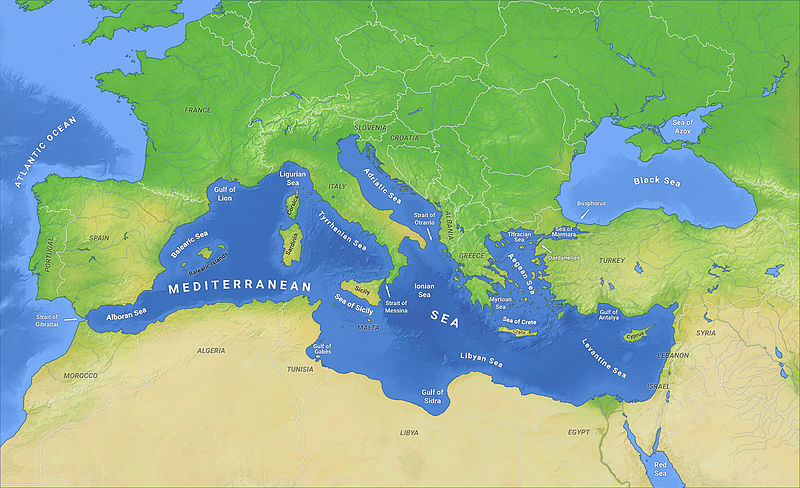
Barbary corsairs or pirates often instilled fear in merchant sailors and passengers traversing the Mediterranean Sea. Their traditional vessels differed from those of the Europeans, but like their western counterparts, these pirates weren’t the only ones to use such conveyances. For example, the felucca – originally designed by Arabs for trade – sailed in both the Mediterranean Sea and Indian Ocean, but in 1814 the United States Navy captured “the fifteen-ton felucca Moon of November” during a raid on Jean Laffite’s enclave at Barataria Bay, fifty miles south of New Orleans on the Gulf of Mexico’s northern coast. (Davis, 192) A felucca possessed a narrow hull and had one or two masts, each of which carried a single lateen sail that was long and triangular. In the early 1700s, western pirates based on Madagascar also adopted feluccas because their swiftness and small size were useful qualities for hit-and-run attacks or in eluding pursuers.
Last edited by Salty Dog on Thu Feb 20, 2020 1:50 am; edited 1 time in total |
|
| Back to top |
|
 |
Salty Dog
Sailing Master
Posts: 10063
192187 Gold -
more...
|
| Posted: Thu Feb 20, 2020 1:45 am Post subject: |
|
|
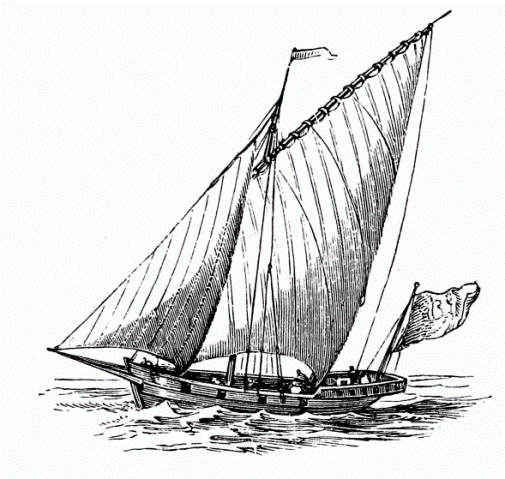
The tartan (from the Arabic tarhida) – similar to the felucca, but smaller – also carried lateen sails on two masts. Oars could be used as an additional means of propulsion. Another factor that distinguished her from a felucca was the forward slope of her foremast or bowsprit. The Barbary corsairs favored such vessels in the seventeenth century; pirates preying on ships in the Red Sea used them in the early years of the next century. Since the tartan (alternative spelling: tartane) was primarily a fishing vessel, pirates liked them because potential prizes wouldn’t suspect peril on seeing the tartan.

 |
|
| Back to top |
|
|
Salty Dog
Sailing Master
Posts: 10063
192187 Gold -
more...
|
| Posted: Thu Feb 20, 2020 1:47 am Post subject: |
|
|
A Turkish tartan, also known as a carmuzel, rode higher in the water than many of the vessels she hunted. This height allowed her pirates to lob grenades or fire guns down on their prey, or set fire to it. She carried up to sixty pirates and eighteen or twenty cannon. On rare occasions when the enemy boarded her, the pirates could withdraw to upper decks at the bow and stern and fire grapeshot into the boarding party from loopholes in the decks’ bulwarks.
The largest traditional vessel most commonly associated with the Barbary corsairs was the galley, which typically measured 180 feet in length and had a beam of sixteen feet. While she did have a mast that could be rigged with a sail, the galley’s principal means of propulsion were fifteen-foot oars worked by slaves. Between the two banks of benches upon which the slaves sat was a gangway, running the length of the ship. Using a whip to encourage faster rowing, an overseer trod back-and-forth along the gangway. Jean Marteille de Bergerac, who served as a galley slave, described the experience in 1701.
Think of six men chained to a bench, naked as when they were born, one foot on the stretcher, the other on the bench in front, holding an immensely heavy oar . . . bending forwards to the stern with arms at full reach to clear the backs of the rowers in front, who bend likewise; and then having got forward, shoving up the oar’s end to let the blade catch the water, then throwing their bodies back on to the groaning bench. A galley oar sometimes pulls thus for ten, twelve, or even twenty hours without a moment’s rest. (Lane-Poole, 215)
“Galley” described a wide variety of oared vessels that had more specific names, depending on size and century. A particular favorite of Barbary corsairs was the galiot (alternatively spelled “galliot” or “galleot”). Oruç (also known as Urūj, Aruj, or Aroudj) Barbarossa was aboard one when he and his men seized two Papal vessels in 1504. Although the number of oars on each side of a galiot varied from sixteen to twenty, most had eighteen. (In Barbarossa’s time, the numbers of oars and rowers manning each bench determined the type of galley, rather than how she was rigged or what sails she carried.)
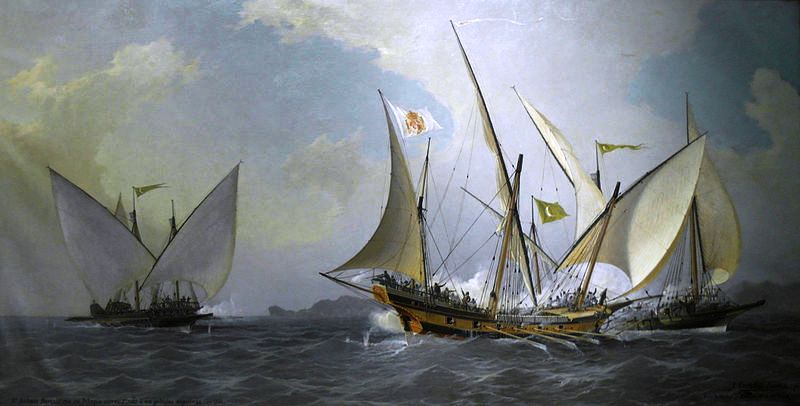
Two Algerian galiots attack a Spanish xebec (center) by Angel Cortellini Sanchex (1738) |
|
| Back to top |
|
|
Salty Dog
Sailing Master
Posts: 10063
192187 Gold -
more...
|
| Posted: Thu Feb 20, 2020 1:48 am Post subject: |
|
|
Speed was the most important asset of corsair galleys and they were designed for cruises of short duration only. The pirates or privateers manning them preferred to ram and board a prize, rather than fire on it. But they did carry one large gun in the bow that fired round shot of twelve to twenty-four pounds, with sixteen being most common. A larger galiot of the late 1500s sometimes mounted two six- or eight-pound guns on either side of the bigger one. She might install a light swivel gun as well that could fire one-pound shot or projectiles, such as musket balls or scraps of metal, to scatter or cut down anyone on the prize’s deck.
Barbary corsairs weren’t the first pirates to use galleys. According to Homer, Greek pirates used galleys propelled by anywhere from twenty to fifty oars. Phoenician warships had two tiers of rowers, which became known as a “bireme,” by the eighth century. Pirates sometimes used small versions of these. Illyrian pirates favored the lembos, a bireme with an open deck, which proved ideal for darting around and evading Roman triremes, galleys with three levels of oars. (Sometime in the second century BCE, Roman shipwrights copied the lembos and the Roman Navy used it as an anti-piracy vessel.) Cilician pirates used another type of bireme called liburnian.

Engraving of naval battle during the Punic Wars shows trireme; the ship in the foreground on the right clearly depicts these. |
|
| Back to top |
|
|
Salty Dog
Sailing Master
Posts: 10063
192187 Gold -
more...
|
| Posted: Thu Feb 20, 2020 1:49 am Post subject: |
|
|
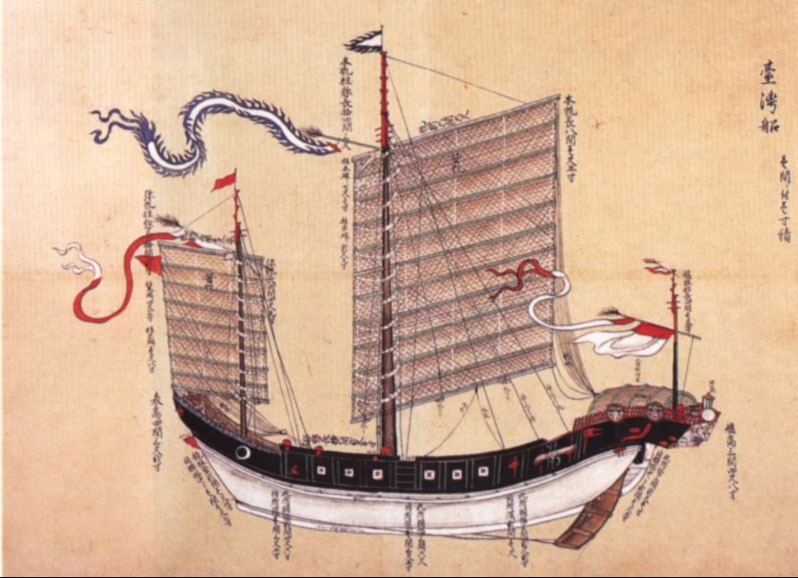
Perhaps the most curious pirate ship was the junk, which has traversed Asian waters since 2800 BCE. The name came from the Portuguese, who referred to the vessels they saw as junco, a corruption of the Indonesian word djong. Fu Xi, a mythical emperor of China, taught the Chinese how to build the junk, sometime during his reign. Junks possessed sternpost rudders and multiple masts long before these came into use on European vessels; they also had watertight compartments. Marco Polo was the first westerner to describe junks in the thirteenth century.
They have a single deck, and below this the space is divided into sixty small cabins, fewer or more, according to the size of the vessels, each of them affording accommodation for one merchant. They are provided with a good helm. They have four masts, with as many sails, and some have two masts which can be set up and lowered again, as may be found necessary. Some ships of the larger class have, besides (the cabins), to the number of thirteen bulk-heads or divisions in the hold, formed of thick planks let into each other (incastrati, mortised or rabbeted). The object of these is to guard against accidents which may occasion the vessel to spring a leak, such as striking on a rock or receiving a stroke from a whale . . . . (Polo, 321-322)
Four, even six, centuries later, pirate junks still resembled those Polo had seen. The only real difference was that these vessels usually had just two or three masts.
 |
|
| Back to top |
|
|
Salty Dog
Sailing Master
Posts: 10063
192187 Gold -
more...
|
| Posted: Thu Feb 20, 2020 1:49 am Post subject: |
|
|
Unlike vessels of the west, whole families lived aboard these junks. This included not only the father and mother and their children, but also the families of their sons. Fanny Loviot, a French adventuress who published an account of her travels in 1858, described this phenomenon after Chinese pirates captured the vessel on which she sailed four years earlier.
The pirates of the Chinese seas make their junks their homes, and carry their wives and children with them on every expedition. The women assist in working the ships, and are chiefly employed in lading and unlading the merchandise. As for the children, they carry them upon their backs in a kind of bag, till they are able to run alone. Each junk is commanded by a chief, and such is the terror of the pirate-name, that, in a country which numbers three hundred and sixty millions of inhabitants, they ravage with im-punity. (Loviot, 84)
In addition, the junk also had a crew of sailors, who lived and ate with the family. The stern cabin housed the master or pirate captain and his family, whereas the rest of the pirates and sailors occupied the main hold. Depending on the size of the junk, there might be several dozen to as many as 200 people on board. The number aboard a pirate junk was even greater, which guaranteed overcrowding, cramped quarters, no privacy, and nowhere to go if a pirate wanted some alone time. Aside from all the people, the confined space held water, cargo, baggage, food, tools and supplies, gunpowder and weapons, and plunder.
To be continued . . . |
|
| Back to top |
|
|
Salty Dog
Sailing Master
Posts: 10063
192187 Gold -
more...
|
| Posted: Thu Mar 26, 2020 7:12 pm Post subject: |
|
|
Part 2
Like their western counterparts, Asian pirates had two places where they could sleep on a junk: below deck in compartments where there was little fresh air, or on the main deck in all types of weather. Each pirate stowed his belongings and slept in a space equaling four square feet.1 A captive occupied an even smaller berth. In December 1806, John Turner, the chief officer of the merchant ship Tay, found himself the “guest” of pirates. He “never [had] more than about eighteen inches wide and four feet long” in which to sleep. (Like, 141)
A succession of pirates seized the western vessel on which Fanny Loviot (right) traveled; the last bunch transferred her and a Chinese merchant to their junk to be held for ransom. After a brief meeting with the pirate chief, the pirates
lifted a kind of trap, about two feet square, and pushed us down into a narrow dark hole below deck, where we had no room to stand upright, and could with difficulty lie at full length. When we sat, our heads touched the flooring above. The trap being left open, we could at least breathe the fresh air, and look up to the sky; but, once shut in, our only light proceeded from a tiny port-hole of some eight inches square, which looked out beside the moving helm, and was not made to open. (Loviot, 103)
One of the pirates now brought us a light, which consisted of a little wick in a saucer of oil. Feeble as it was, it yet sufficed to light up the walls of our narrow dungeon. Scarcely had I looked round, when I uttered a cry of horror. Ceiling, walls, and floor were peopled by a multitude of huge velvety spiders, enormous beetles, and monstrous wood-lice, horned and shiny. In another instant, three or four great rats rushed out of a corner, and ran between my feet. (Loviot, 106)
She also mentioned the presence of an altar and the manner in which the pirates prayed every evening. On the eighth day, the pirates sighted a steamer and abandoned their junk. The former vessel eventually rescued Fanny Loviot. |
|
| Back to top |
|
|
Salty Dog
Sailing Master
Posts: 10063
192187 Gold -
more...
|
| Posted: Thu Mar 26, 2020 7:13 pm Post subject: |
|
|
Living in such a confined space occupied by so many people created close-knit societies governed by specific rules. It mattered not whether you were a sailor, a family member, a fisherman, or a pirate. You either adhered to these limitations, or you suffered the consequences. When Zheng Yi (formerly, Cheng I) and other pirate chieftains came together in 1805 to form a confederation of more than 50,000 pirates, their pact included rules pertaining to their junks and their behaviors.
1. We have agreed that our large and small seagoing vessels will be arranged in seven branches as Heaven (Tian), Earth (Di), Black (Xuan), Yellow (Huang), Universe (Yu), Cosmos (Zhou), and Vast (Hong). Each branch must record the nicknames of their commanders in a register. Every fast boat must have its branch name and registration number written on the bow and must fly the branch’s banner on its foremast. If the bow does not display the branch name and registration number or the foremast displays a banner with the wrong color, then that vessel and its weapons will be confiscated and the commander executed.
2. Each branch shall have its own name and number. If any [vessel] falsely displays another branch’s name and banner, then as soon as it is discovered the vessel and its weapons will become the property of the whole group. [Because] the commander has intentionally cheated the whole group then the whole group will decide his fate.
8. If [the commander of a] flagship has something to discuss concerning the whole group then he should hoist a flag on his mainmast and the big bosses of each branch should come to confer. If a branch leader has an order to transmit to his fast boats, he should hoist a flag on the third mast, and all junks must assemble to listen to the orders. Those who do not assemble will be held in contempt and punished accordingly.2 (Antony, Pirates, 122-124) |
|
| Back to top |
|
|
Salty Dog
Sailing Master
Posts: 10063
192187 Gold -
more...
|
| Posted: Thu Mar 26, 2020 7:13 pm Post subject: |
|
|
Another preferred vessel was the hung-t’ou or “redheaded” cargo carrier of Guangdong (Canton). “Built to withstand the stormiest seas, these vessels were constructed of ironwood and often ran more than 150 feet in length. The name . . . derived from the fact that all junks from [Guangdong] were required to have red bands on their hulls.” (Murray, 91) Two hundred of the pirate confederation’s junks in 1809, the peak of the pirates’ power, were ocean-going junks. The remaining 1,800 junks in their fleet consisted of smaller vessels such as the hai-ch’uan – merchant junks converted to pirate junks with an average beam of fourteen feet and a length of forty feet – and looked similar to a horse trough; and river junks, which had descriptive names: long dragons, serpent boats, snake boats, and sampans.
Not only were pirate junks able to outmaneuver and outsail naval war junks, they also carried armament capable of firing heavier projectiles. The heaviest shot in the navy weighed one catty (about one and one-third pounds or 600 grams), whereas the pirates’ cannonballs might weigh thirteen or fourteen catties.3 The largest pirate junk carried twelve guns that fired six- or eight-pound round shot. In addition to these large guns, pirates also mounted lantaka, a type of swivel gun. The pirates themselves were armed with swords, lances, and muskets.
Japan also had pirates, who were known collectively as wako in Japanese, wokou in Chinese, or waegu in Korean. Although their havens were located on Japanese islands, these pirates were primarily men from China and Korea, with a small number of Portuguese added into the mix. During the 1300s, they walked a fine line between being merchants and pirates, depending on the occasion. |
|
| Back to top |
|
|
Salty Dog
Sailing Master
Posts: 10063
192187 Gold -
more...
|
| Posted: Thu Mar 26, 2020 7:14 pm Post subject: |
|
|
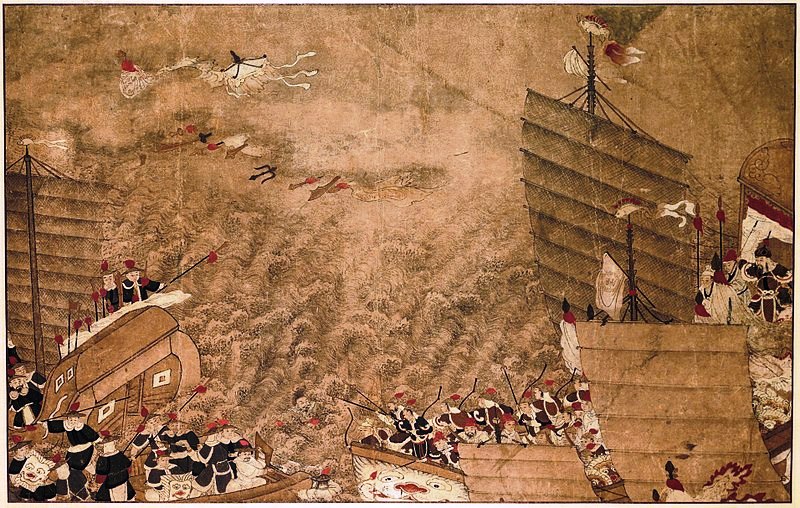
The wako favored small and large vessels. The former navigated coastal waters, while the latter were used to sail to the mainland. Propulsion came from either straw mat sails or oars, and these vessels could carry up to 150 koku.4 A small cabin occupied the stern of the boat. During the thirteenth century, these boats were ideal for conducting hit-and-run raids. At the moment of boarding, the pirates stood on the deck of their ship and the mast would be lowered to serve as a bridge between their vessel and the enemy’s.
Two hundred years later, Japanese pirates acquired large warships of 400 koku. While the means of propulsion remained the same, such vessels also had two yagua, tall towers, at either end of them. These were used as fighting platforms.
To transport their plunder, the wako also employed kenminsen, a ship more commonly used for trade and diplomacy with Korea and China beginning in the fourteenth century. One such vessel measured about 180 feet in length and had two masts. The capacity of her cargo hold averaged 2,000 koku, which was ideal for filling with plunder. A picture of one of these vessels, which often had cabins, appeared in the Jingu Kogo Engi emaki scroll, painted in 1433. It depicted a ship with two cabins, one at the stern and one amidships, with a slave or female captive in the latter. |
|
| Back to top |
|
|
Salty Dog
Sailing Master
Posts: 10063
192187 Gold -
more...
|
| Posted: Thu Mar 26, 2020 7:15 pm Post subject: |
|
|
Between 1467 and 1615 – a time known as the Sengoku Period or the Age of Warring States – petty warlords known as daimyo decided to add piracy to their repertoire. One of their vessels was the atakebune, a ship used solely for fighting. Oars propelled her through the water, but she did have one sail “slung from a mast that could be pivoted and laid along the length of the ship.” (Turnbull, 35) When the mast was lowered, it was comprised of three sections and rested on supports built for that purpose. The atakebune could carry 800 koku. This vessel was also used by the kaizoku of the 1500s. Her complement consisted of eighty rowers and sixty fighters, half of whom were armed with arquebuses. She also carried three cannon. The atakebune was a curious ship indeed, for she looked like:
a large box with a heavy prow, resembling nothing less than a floating wooden castle with a tate ita (gunwale) of planking 6-10cm (2½-4in.) thick. Along the four sides loopholes were cut for guns and bows, leaving no dead space that was not covered by defensive fire. Part of the tate ita was hinged, allowing it to be let down to form a bridge across which an enemy vessel could be boarded. (Turnbull, 35)
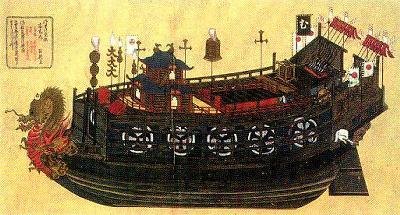 |
|
| Back to top |
|
|
Pirate
Helmsman
Posts: 5927

117641 Gold -
   
|
| Posted: Thu Mar 26, 2020 7:16 pm Post subject: |
|
|
Be nice to have some of these ships in SMP wouldn’t it? |
|
| Back to top |
|
|
Salty Dog
Sailing Master
Posts: 10063
192187 Gold -
more...
|
| Posted: Thu Mar 26, 2020 7:18 pm Post subject: |
|
|
The kaizoku, another group of sea bandits during this period of unrest in Japan, also used two other vessels: sekibune and kobaya. The former had a bow that was long and pointed. She was also a narrower vessel that used bamboo, instead of heavy planks, for the tate ita. She transported a complement of thirty samurai and forty crewmen. Her armament consisted of twenty arquebuses and one cannon. The kobaya, on the other hand, sailed with a ratio of ten samurai to twenty oarsmen and was armed with only eight arquebuses. Rather than a tate ita, she had a frame around which thickly padded cloths were hung to protect the samurai from arrows. Whereas the sekibune and atakebune were warships, the kobaya served as a scout, did reconnaissance, or carried messages. All three vessels comprised the fleets of the Inland Sea pirates.
Not all curious pirate ships were found in eastern waters. Among Granuaile O’Malley’s fleet was a clinker-built galley with a shallow draft, up to thirty oars, and one sail.5 She offered Sir Henry Sidney, Lord Deputy of Ireland, the use of “three gallyes and two hundred fightinge men” in 1576/77. (Chambers, 12) In 1599, during the reign of Elizabeth I, the Calendar of State Papers, Ireland mentioned:
There are three very good galleys with Tibbott ne Long, son to Grany O’Malley . . . that will carry 300 men apiece. . . . There are no galleys in Ireland but these. (Chambers, 11)
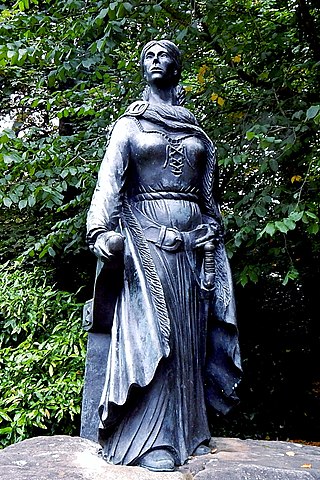
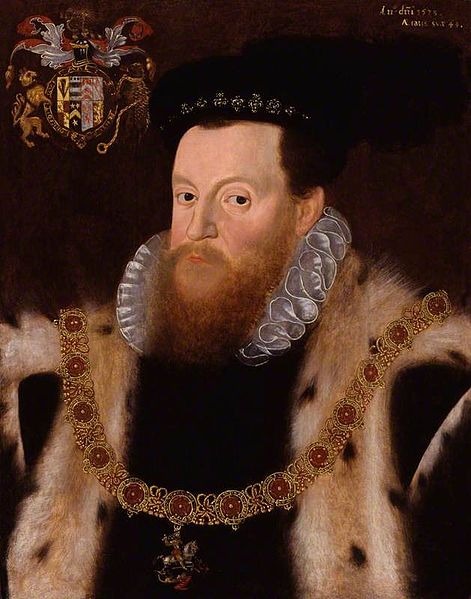
Top: Grainne Mhaol Ni Mhaille (Grace O'Malley), photograph by Suzanne Mischyshyn, 2013 (Source: Wikimedia Commons)
Bottom: Sir Henry Sidney by Arnold Bronckorst, 1573 (Source: Wikimedia Commons) |
|
| Back to top |
|
|
Salty Dog
Sailing Master
Posts: 10063
192187 Gold -
more...
|
| Posted: Thu Mar 26, 2020 7:18 pm Post subject: |
|
|
Two years later, an English sea captain engaged one of her galleys off the coast of Mayo, Ireland. According to him, the vessel was “rowed with thirty oars and had on board ready to defend her 100 good shot.” (Chambers, 11)
Viking Longboat by Ningyou, 2006 (Source:
https://commons.wikimedia.org/wiki/File:Viking_longship.png)The precursor of Granauile’s vessel might have been the Viking langskip (longship). A typical Norse vessel was used in raiding, was open to the elements, and possessed a keel, thirty-six-foot mast, one rectangular sail, and a side rudder. Oars were also used to propel her through the water, and she could achieve a speed up to ten knots. The pirates sat on their sea chests to row. Their shields were placed in a shield rack on either side of the vessel and tied in place. The deck planks were often made of pine, but not nailed into place, which allowed them to be removed or to stow plunder and other items under them.
Artifacts found on the Gokstad (built circa 890 AD, buried around 900, and found in 1879) suggested that it could carry sixty to seventy men, which allowed half to rest while the other half rowed. A small raised platform at the stern provided the helmsman with a place to stand or sit to work the rudder. Sometimes, longships placed carved animal heads, such as a dragon or a snake, on the stem. Their purpose has been lost to history, but interpretations suggest several reasons: a) to indicate the status of the owner; b) to intimidate the prey; c) to signal readiness when traveling with other longships; or d) to protect the pirates from ghosts and evil spirits. |
|
| Back to top |
|
|
Salty Dog
Sailing Master
Posts: 10063
192187 Gold -
more...
|
| Posted: Thu Mar 26, 2020 7:19 pm Post subject: |
|
|
These are but a sampling of curious ships that struck fear in their victims just as the pirate ships of the west did. Their designs differed to suit the environments in which they sailed. Their names might differ, but these vessels suited the pirates because they had shallow drafts, were faster than their prey, and could easily evade authorities when necessary.
Notes:
1. In comparison, a regular-size twin mattress measures thirty-eight inches wide and seventy-five inches long, which equates to roughly nineteen square feet.
2. A note in Robert Antony’s Pirates in the Age of Sail explains that “fast boats” were fishing and coastal junks that had two masts. Pirates favored these “because they handled well both at sea and in coastal waters.” (122)
3.These measurements come from Like Froth Floating on the Sea, but the comparison weights can be found in Merriam-Webster’s definition of “catty.”
4. A koku was the amount of rice a man would eat in a single year. The more rice carried, the more wealth a field yielded for its owner. One hundred fifty koku equated to 39½ gallons or 180 liters.
5. Extant descriptions of O’Malley’s galleys indicate that these vessels were substantially bigger than the galleys (known as birlinns) of the Western Highlands of Scotland. A replica built in the 1990s was based on those descriptions. Information and pictures of Aileach can be found here and here, or watch this video. |
|
| Back to top |
|
|
|
|
You cannot post new topics in this forum
You cannot reply to topics in this forum
You cannot edit your posts in this forum
You cannot delete your posts in this forum
You cannot vote in polls in this forum
|
Powered by phpBB © 2001, 2005 phpBB Group |
|


