
Trading Companies, an Introduction
| View previous topic :: View next topic |
| Author |
Message |
Salty Dog
Sailing Master
Posts: 10063

192187 Gold -
         more... |
 Posted: Tue Apr 21, 2020 3:15 pm Post subject: Trading Companies, an Introduction |
 |
|
Trading Companies
An Introduction
By Cindy Vallar
In 1498, Vasco da Gama made a daring journey. He sailed around the Cape of Good Hope to India and back home to Portugal – an astounding feat for several reasons, but his overall goal was twofold. He wanted to acquire a greater volume of luxury items to sell at home, and to bring these items directly to market, rather than through middlemen via long-established trade routes at exorbitant prices. His success gave rise to more such journeys by others, but these ventures involved significant outlays of cash with high risks attached. For example, a journey to Asia had to be taken in large ships, which were the most expensive to build and outfit. They also required the greatest number of men to work the vessel. And travel by sea was fraught with hazards: accidental fire, water leaks, hidden shoals, gale-force winds or mind-numbings, and terrifying tempests. A devastating example of the last was the hurricane that wrecked eleven of twelve treasure ships that set sail from Havana, Cuba in July 1715. Miguel de Lima y Melo, who owned the Urca de Lima, detailed what happened.
The sun disappeared and the wind increased in velocity coming from the east and east northeast. The seas became very giant in size, the wind continued blowing us toward shore, pushing us into shallow water. It soon happened that we were unable to use any sail at all, making bare our yards, mostly due to the wind carrying away our sails and rigging, and we were at the mercy of the wind and water, always driven closer to the shore. Having then lost all of our masts, all of the ships wrecked on the shore, and with the exception of mine, broke to pieces. We lost only thirty seamen and marines, who were carried away by waves while in the waist of the ship. (Urca de Lima) |
|
| Back to top |
|
 |
Salty Dog
Sailing Master
Posts: 10063
192187 Gold -
more...
|
| Posted: Tue Apr 21, 2020 3:17 pm Post subject: |
|
|
To minimize such costs and risks, private merchants formed trading companies. These were set up as joint-stock ventures, where each person bought however many shares he (or she) could afford with the knowledge that should the worst happen, all would be lost. The more people who bought into the company, the less risk each person might have to absorb. If the venture was successful, the return on their investment would make a tidy profit for their coffers.
Once sufficient funds were amassed, these trading companies often sought royal approval, so that the company might acquire a monopoly that allowed it to be the only company to trade with a particular country or region of the world in which they wished to set up trading posts (also known as factories). In addition to the ships and crews, these companies also required men to act as their agents in the country where they traded. The agents, themselves, were Europeans – although they did hire local people to assist in their work – and they were responsible for acquiring exports, selling imports, and obtaining the best prices possible to assure maximum profits for the company. The most senior agent often acted as an emissary on behalf of his homeland to secure trading rights and negotiate treaties with local rulers.
The English were the first to create a joint-stock company. Founded in 1551, the Merchant Adventurers – or more formally, the “Mystery and Company of Merchant Adventurers for the Discovery of Regions, Dominions, Islands, and Places unknown” – was organized to fund an expedition to the White Sea (part of the Barents Sea) in hopes of finding a northeast passage to China. Other sixteenth-century ventures included the Muscovy Company (1555, initially set up to trade with Russia and later explored the Arctic); the Company of Merchants of the East (also known as the Eastland North Sea Company, established in 1579 to trade with independent Scandinavian and Baltic countries); and the Levant Company (1581).
Colloquially known as the Turkey Company, but more properly called the Governor and Company of Merchants of the Levant, this company conducted trade with the Ottoman Empire. Later, its reach expanded to include Venice and the Middle East. The Levant began operating with fourteen ships with a cargo capacity of 200 to 350 tons, and two years after the granting of its charter, the first voyage departed England. Its agent (called “consul”) established an embassy in Constantinople, and set up trading posts in Smryna and Aleppo. Carpets, cotton, currants, oils, silks, and wines were the Company’s principal imports. |
|
| Back to top |
|
|
Salty Dog
Sailing Master
Posts: 10063
192187 Gold -
more...
|
| Posted: Tue Apr 21, 2020 3:18 pm Post subject: |
|
|
The Mediterranean Sea was the prime hunting ground for the corsairs of North Africa (Algiers, Morocco, Tunis, and Tripoli). These marauders caused sufficient problems to gain William Shakespeare’s attention. In Act 1, Scene 3 of Macbeth three witches are conversing when the first warns of the danger of sailing to the Levant Company’s factory in Aleppo.
Her husband’s to Aleppo gone, master o’ the Tiger:
But in a sieve I’ll thither sail,
And, like a rat without a tail,
I’ll do, I’ll do, and I’ll do.
Between 1609 and 1616, pirates seized 466 of the Levant’s vessels. After the Dey of Algiers imprisoned the Levant’s consul, the Company moved out of North Africa and established a trading post in Leghorn (Livorno) where their consuls often found cargo stolen from their ships for sale in the shops and markets of Italy.
The English Civil War caused the Company to suffer a recession, but after a new charter was granted in 1661, the Levant Company experienced renewed prosperity. Sixty vessels sailed each year, and their encounters with pirates lessened. It continued to operate until 1825.
The earliest chartered company with ties to Asia, the Portuguese East India Company, came into existence in 1628, but failed five years later because it lacked sufficient investments and outlays exceeded returns. It also preferred not to modernize since its competitors – the Dutch, the English, and the French – proved more adept at trading there. Instead, it established a more successful venture by going in the opposite direction. The Portuguese Company (1649) set up operations in Brazil, focusing on commodities of wine, olive oil, grain, codfish, sugar, tobacco, hides, and cotton. It did well until King João IV died in 1656. Two other Brazilian ventures, also established in the seventeenth century, proved more successful: the General Company for the Trade of Grão-Pará and Maranhâo, and the General Company for the Trade of Pernambuco and Paraíbo. |
|
| Back to top |
|
|
Salty Dog
Sailing Master
Posts: 10063
192187 Gold -
more...
|
| Posted: Tue Apr 21, 2020 3:19 pm Post subject: |
|
|
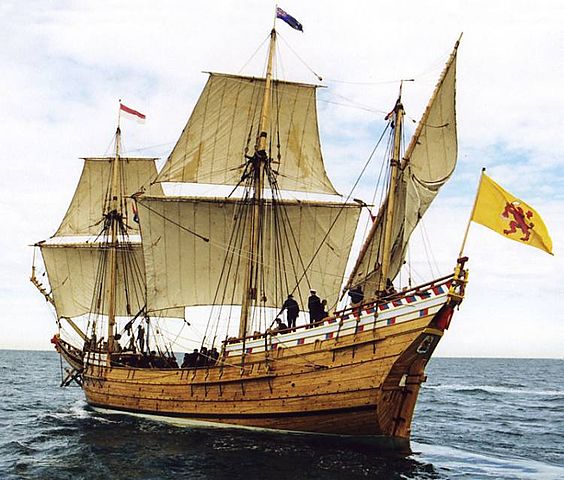
The Dutch began trading with Asian countries in the last decade of the sixteenth century. The first voyage, comprised of four ships, left Texel in April 1595. Three years passed before the fleet returned, minus one ship and with only one-fourth of the men who originally left the Netherlands. By 1601, fourteen separate entities were competing with each other for Asian trade. Such rivalry proved less than ideal, so the States-General of the United Provinces of the Netherlands intervened. The result was the establishment of a single entity, Vereenigde Oostindische Compagnie (VOC, or the United Netherlands Chartered East India Company), the following year. The shareholders elected seventeen directors, known as the “Council of 17,” to oversee all operations of the trade monopoly, the charter of which granted the VOC powers that in essence made it a mini-state. It did not have to pay customs on the goods it imported. It could raise its own army and navy; wage armed conflict; build forts; print its own currency; and conduct diplomatic negotiations. In only thirty years, its success surpassed that of the Portuguese, and eventually became the most successful and largest of the East India companies.
The VOC’s ships, which were often referred to as “East Indiamen,” were built at the Company’s Amsterdam shipyard, where 1,500 employees produced an average of three vessels each year. At the peak of its power, the VOC maintained an armed force of 10,000 soldiers and a fleet of forty warships and 150 merchantmen. In 1625, 4,500 people worked for the VOC. Seventy-five years later, that number increased to 18,117, and in 1753, the Company employed 24,879. During its 200 years of operation, the VOC made 4,789 trips to Asia and 3,401 return passages to the Dutch Republic. In that time, the Company lost 105 outbound and 141 inbound ships out of a total of 1,770 vessels.
 |
|
| Back to top |
|
|
Salty Dog
Sailing Master
Posts: 10063
192187 Gold -
more...
|
| Posted: Tue Apr 21, 2020 3:21 pm Post subject: |
|
|
The VOC’s early entry into Asia permitted the Dutch to establish key bases on Indonesian islands, with their capital situated on Batavia (Jakarta). To keep their sea trade route open, the Company also erected a fortified trading post at the Cape of Good Hope. Primary imports were pepper and spices, but as time passed, coffee from Java became equally important.
 |
|
| Back to top |
|
|
Salty Dog
Sailing Master
Posts: 10063
192187 Gold -
more...
|
| Posted: Tue Apr 21, 2020 3:22 pm Post subject: |
|
|
The beginning of the end came during the Fourth Anglo-Dutch War (1780-1784) when Company finances plummeted. Mismanagement, corruption, high mortality rates among workers in Batavia, increasing expenditures, and France’s invasion during the Napoleonic War led to the dissolution of the VOC in December 1799.
Sir Thomas Smythe by Simon De Passe 1617 (Source: Wikimedia Commons https://commons.wikimedia.org/wiki/File:Sir_Thomas_Smythe.jpg)Never one to let other nations reap all the benefits, the English entered the fray two years before the Dutch. Queen Elizabeth I granted a royal charter to the Company of Merchants of London trading to the East Indies in 1600, giving it the exclusive right to all trade conducted between the Cape of Good Hope and the Strait of Magellan (South Africa to Chile). It more formal circles the venture became known as the East India Company (EIC) or the Honorourable East India Company (HEIC) and informally as “John Company.” Run by an elected board of directors, the Company’s first governor or chairman was Sir Thomas Smythe, who at various times in his career also served as governor of the French Levant Company, the Muscovy Company, the North-West Passage Company, and the Virginia Company. Such cross-hiring wasn’t uncommon. A number of the EIC’s original investors and organizers had ties to the Levant Company, and many senior factors had previously worked for that Company.
The EIC’s first voyage to Asia, which cost a total of £68,000, departed London in February 1601, and consisted of four ships. The vessels returned in September 1603. Initial journeys were funded by individual shareholders, who also reaped the profits. This changed in 1612 when the Company itself sent out ships as far as Japan, and established two factories in India. Between its inception in 1600 and the end of its monopoly in 1833, Company ships made about 4,600 voyages. These vessels were the largest merchant ships available because the outbound journey alone could take six months or more and, with shareholders waiting a minimum of two years to see a return on their investment, the ships needed to carry as much cargo as possible.
Initially, the EIC hired ships to transport their exports and imports. This changed in 1609 once the Company established its own dockyards in Deptford, England. Here, some of the grandest and most lavish vessels of the day were built. The EIC also armed these ships with an array of guns to fight pirates, particularly prevalent around Malay (Malaysia) and the Indian Ocean, and to protect against rival companies and nations. In 1681, the Company owned around thirty-five ships of 100 to 775 tons. During the following seven years, its shipyard constructed sixteen East Indiamen with the smallest having a capacity of 900 tons and the largest, 1,300 tons. When the Somerset was launched in 1738, she had a length of 100 feet, could carry 948 tons, and was armed with eight 9-pound guns and twenty-two 6-pounders. |
|
| Back to top |
|
|
Salty Dog
Sailing Master
Posts: 10063
192187 Gold -
more...
|
| Posted: Tue Apr 21, 2020 3:23 pm Post subject: |
|
|
In 1653, Oliver Cromwell opted not to renew the EIC’s charter, which allowed other merchants to enter this lucrative market. This venture into free trade eventually demonstrated to the government that a joint-stock company that was well regulated and held a monopoly was a better means of organizing overseas trade, and Cromwell restored the Company’s monopoly four years later. During the Restoration, King Charles II expanded the EIC’s charter, empowering the Company to acquire and govern territories, negotiate treaties, oversee its own military, wage armed conflict, and print its own currency.
By 1708 there were actually two East India companies trading with Asia – the Old East India Company and the New East India Company. That year, they merged into a single entity known as the United Company of Merchants of England Trading to the East Indies. In 1813, the EIC ceased to be the sole importer of Asian goods to England, with the exception of tea from China. That product remained its exclusive domain until 1833. Thereafter, the Company administered India for the British government until the Crown assumed that responsibility in 1858 following an uprising. The official end for the EIC came sixteen years later.
 |
|
| Back to top |
|
|
Salty Dog
Sailing Master
Posts: 10063
192187 Gold -
more...
|
| Posted: Tue Apr 21, 2020 3:25 pm Post subject: |
|
|
In the early years of trading in Asia, the VOC and EIC were opponents in a virtual war. They did reach an agreement to bring an end to their disputes in 1619, but peace lasted a total of sixty minutes. The animosity reached its peak four years later on Ambon in the Spice Islands(Maluku Islands or Moluccas). Initially, the Portuguese used the island, but the Dutch took control and erected a fortress there in 1605. Eighteen years later, during a truce, VOC agents massacred English merchants at Ambon. Thereafter, the British focused on their trade with India, establishing factories in Surat, Chennai (Madras), Calcutta (Kolkata), and Bombay (Mumbai). In addition to pepper, the Company imported large quantities of cotton cloth and silk. Later, they dominated the lucrative tea trade of China. Aside from these imports, another benefit that rose out of the EIC’s voyages was the compilation of early coastal sea charts.
France entered the Asian trade much later than the English and the Dutch. La Compagnie française des Indes orientales (French East India Company) was founded in 1664 and lasted only until 1719 because it lacked sufficient capital and wasn’t well run. Its successor was the Compagnie perpétuelle des Indes, established that same year. In time, it became a dominant player, remaining in existence until 1769. The Compagnie’s Indian headquarters was in Pondicherry (Puducherry, located near Madras), and comptoirs (trading posts) were established in Chandernagore (Chandannagore), Karikal, and Machilipatnum (Bandar). In France, the Compagnie was based in Lorient, a port in Brittany, where its naval officers trained, imports were auctioned, affairs were administered, and ships were built. Seventy percent of the officers staffing these vessels came from Brittany, particularly Saint Malo. These men often came from a core group of wealthy families, most of which were involved in merchant trade rather than the navy. On the other hand, the Compagnie could conscript seamen from the reserves of France’s Royal Navy. In 1723, the Compagnie owned seventy-six ships, each capable of carrying more than 100 tons of cargo. All were armed, some having more than forty guns, to fight pirates or defend the country in times of war. Ten lesser ships carried between thirty and forty cannons, while twenty-one others had sixteen to thirty. Twenty-five years later, the Compagnie’s fleet was downsized to only twenty-six vessels, although that number increased again by the mid-1750s. The cargo capacity of vessels traveling to and from China or India was between 450 and 600 tons. During a fourteen-year period, beginning in 1756, a Compagnie captain earned an average of 33,000 livres (roughly £2,475) in a single voyage. |
|
| Back to top |
|
|
Salty Dog
Sailing Master
Posts: 10063
192187 Gold -
more...
|
| Posted: Tue Apr 21, 2020 3:26 pm Post subject: |
|
|
Other countries also entered the fray: the Scottish East India Company (1618), the Ostend Company of the Austrian Netherlands (1715-1732), the Swedish East India Company (1731-1813), the Prussian East India Company (1754-1765), and the Danish East India Company (1616-1807). The Swedish EIC made only 132 voyages during its eighty-two years, but almost all of their ships were built in Sweden. What distinguished these players from the more successful ones was their reliance on the expertise and money of people who once worked for or funded the Dutch and English companies.
Spain had its own companies, whose focus was centered more on trade with their colonies. For example, in 1714, Spaniards established the Honduras Company, although not much else is known about this venture. Fourteen years later, the Spanish Caracas Company was founded by Basques who primarily imported cocoa. Other commodities of interest to them were gold, silver, tobacco, and hides. When Charles III imposed “free trade” regulations in 1778, the company went into decline. Similar ventures included the Company of the Philippines (1733); the Company of Buenos Aries, Tucumán, and Paraguay; the Royal Trading Company of Havana (1740); and the Royal Trading Company of Barcelona (1755).
In addition to trade, these joint-stock companies were also involved in efforts to explore and colonize lands beyond Europe. Four such English companies were the Virginia Company of London (1606), the Plymouth Company of London (1606), the Somers Isles Company (1615, Bermuda), and the Massachusetts Bay Company (1629). A later company, established in 1670, was chartered as the Gentlemen Adventurers Trading into Hudson Bay. Its primary goal was to find a Northwest Passage, but its trade involved the importation of furs. But England wasn’t the only country with companies who ventured to the New World. |
|
| Back to top |
|
|
Salty Dog
Sailing Master
Posts: 10063
192187 Gold -
more...
|
| Posted: Tue Apr 21, 2020 3:26 pm Post subject: |
|
|
A number of companies were founded to conduct trade in the West Indies, although that wasn’t always their primary directive. Nor were these occidental companies as successful or lucrative as their oriental counterparts. A lesser-known company was the Svenska Västindiska Kompaniet, or the Swedish West India Company. Its royal charter was to manage Saint-Barthélemy, after Louis XVI of France traded the Caribbean island to Sweden in 1784. Nya Sverige Kompanie or New Sweden Company (1638-1655) settled along the Delaware River in what was then called New Sweden (Delaware). Cardinal Richelieu founded La Compagnie des Îles de l’Amérique (French Company of the American Islands) in 1631, which ceased to operate circa 1650. It founded and/or administered the Caribbean islands of Guadaloupe, Martinique, Saint Lucia, and Saint Christopher (Saint Kitts). Established in 1664, la Compagnie d’Occident merged with la Compagnie française des Indes orientales to become la Compagnie perpétuelle des Indes. While the latter half focused on the Far East, the former half explored and settled Louisiana, earning the nickname “Mississippi Company.” The united company existed until 1720. Two companies that failed spectacularly were the Company of Scotland (1695) and the South Sea Company (1711-1720). The Scots tried to set up a trading colony on the Isthmus of Darien (Isthmus of Panama), while the British focused on South America. |
|
| Back to top |
|
|
Salty Dog
Sailing Master
Posts: 10063
192187 Gold -
more...
|
| Posted: Tue Apr 21, 2020 3:27 pm Post subject: |
|
|
The trading companies with the most notorious reputation, however, were those established along the west coast of Africa. The primary commodity in which they dealt was the exportation of slaves, although gold and ivory were also desirable. The Scots established the Scottish Guinea Company circa 1634. Swedes took over a company originally founded by the Dutch and renamed it the Afrikanska Kompaniet or Guinea Kompaniet, (Swedish Africa Company, 1649-1658). Prussia’s Brandenburgisch-Africanische Compagnie (Brandenburg African Company) was founded in what is Ghana today and operated between 1682-1717. The more widely known venture, however, started as the Company of Royal Adventurers Trading to Africa.
King Charles II granted the Company a charter in 1660, with the understanding that his brother James, Duke of York, would govern it. Its initial purpose was to seek gold around the Gambia River, but three years later another commodity was added to the charter – slaves. Even so, increasing debt led to the Company’s collapse in 1671. It reemerged a year later under a new charter as the Royal African Company (RAC). This time around, the focus was solely on slavery and the infrastructure necessary to support such trade. Aside from erecting forts for protection, the RAC built factories in which its agents conducted business. Once the RAC lost its monopoly in 1698, it ignored its infrastructure, allowing these structures to slowly crumble and become more susceptible to attack. The RAC continued its involvement in the slave trade until 1731, after which, it returned to the buying and selling of gold and ivory.
This introduction to joint-stock trading companies merely skims the surface of these ventures. Upcoming articles will focus on specific companies and their interaction with pirates, as well as the impact these interactions had on both the companies and the pirates. |
|
| Back to top |
|
|
|
|
You cannot post new topics in this forum
You cannot reply to topics in this forum
You cannot edit your posts in this forum
You cannot delete your posts in this forum
You cannot vote in polls in this forum
|
Powered by phpBB © 2001, 2005 phpBB Group |
|


