
The Royal African Company and Pirates
| View previous topic :: View next topic |
| Author |
Message |
Salty Dog
Sailing Master
Posts: 10063

192187 Gold -
         more... |
 Posted: Tue Sep 22, 2020 1:46 am Post subject: The Royal African Company and Pirates |
 |
|
The Royal African Company and Pirates
By Cindy Vallar
The Church says that the Earth is flat, but I know that it is round, for I have seen the shadow on the moon, and I have more faith in a shadow than in the Church.
This quote, often attributed to Ferdinand Magellan, epitomized what compelled Westerners to go beyond the known world to explore the unknown in the sixteenth century.1 At the time, China was more advanced technologically. The Ottoman Empire was knocking at Europe’s back door. Religious conflicts, as well as other discord, plagued the continent. What Europe needed to gain the ascendency was an opportunity to expand its limited horizons. That became possible with the development of a new ship that was carvel-built, had a rudder, and three masts. It was the ability to carry a combination of square and lateen sails on more than a single mast that made her “well balanced and more maneuverable.” (Lavery, 69)
 |
|
| Back to top |
|
 |
Salty Dog
Sailing Master
Posts: 10063
192187 Gold -
more...
|
| Posted: Tue Sep 22, 2020 1:48 am Post subject: |
|
|
When Europeans ventured beyond known waters into unknown waters, they had two options as to which way they could sail. And the place they all wanted to go was Asia, where they could gain exotic cargoes to bring home to sell at enormous profit. If they went west, as Christopher Columbus did, they eventually encountered the West Indies and the Americas. If they went south, they traversed the Atlantic bordering the west coast of Africa in order to go around the Cape of Good Hope into the Indian Ocean. The first to succeed in this endeavor was Bartolomeu Dias in 1488.
Dias was not the first explorer to venture along the coast of Africa. Another Portuguese, Pedro de Sintra, charted Sierra Leone in 1462. The fortified trading posts that they built dealt initially in gold and ivory, but slaves were soon added to those transactions. Nor were the Portuguese the only Europeans to establish commercial ventures on this continent. The Dutch and French were soon joined by the English.
Established in 1672 and according to its charter, the Royal African Company (RAC) “had the whole, entire and only trade for buying and selling bartering and exchanging of for or with any Negroes, slaves, goods, wares, merchandise whatsoever.” (Brooks, 162) Their ships departed England from Liverpool and Bristol, and sailed to a number of trading posts and forts along the coast of West Africa. The latter were built more to protect their trade and agents from competitors like the French and Portuguese. The problem was that it took a lot of money to maintain them. Shareholders preferred pocketing their seven percent dividends rather than paying the £20,000 for the forts’ annual upkeep. As a result, this neglect made them easier to fall prey to pirate attacks, with 1715 being the first known complaint of such marauding.


Top: Cape Coast Castle as the British rebuilt it in 18th century. Bottom: Map of African coast depicting location of Cape Coast Castle (1869).
(Sources: Wikimedia Commons and Wikimedia Commons) |
|
| Back to top |
|
|
Salty Dog
Sailing Master
Posts: 10063
192187 Gold -
more...
|
| Posted: Tue Sep 22, 2020 1:49 am Post subject: |
|
|
Living and working in this hostile environment was not easy and the RAC, more often than not, made the conditions even less desirable. John Atkins, the surgeon aboard H.M.S. Swallow, visited Cape Coast Castle, the main base of operations on the continent, in June 1721.
The Factory consists of Merchants, Factors, Writers, Miners, Artificers and Soldiers; and excepting the first Rank, who are the Council for managing Affairs, are all of them together a Company of white Negroes, who are entirely resigned to the Governour’s Commands, according to the strictest Rules of Discipline and Subjection; are punished (Garisson fashion) on several Defaults, with Mulcts, Confinement, the Dungeon, Drubbing, or the Wooden Horse; and for enduring this, they have . . . a Salary sufficient to buy Canky, Palm-Oil, and a little Fish to keep them from starving: . . . the General . . . pays them in Cracka, a false Money which is only current upon the spot, and disables them from taking any advantage of buying Necessaries from Ships coasting down. . . . When the Man is too sober to run in Debt, there are Arts of Mismanagement, or loss of Goods under his Care, to be charged or wanting. Thus they are all liable to be mulcted for Drunkenness, Swearing, Neglects, and lying out of the Castle, even for not going to Church . . . and thus by various arbitrary Methods, their Service is secured durante bene placito. (Atkins, 90-91)2
In addition to these hardships, disease was a major drain on personnel. Sixty-nine employees came to the Gold Coast for the first time in 1719. Within four months half of them had died.
Conditions were only worse in the other forts. According to the RAC’s chief surgeon in 1725,
I have . . . visited your forts at Anamaboe, Winneba, Tantumquerry and Acra, and indeed they more resemble haunted houses than garrisoned forts, having one ghost above stairs and perhaps 2 or 3 at most below, spinning out a life that is a real burden to them, in miserable conditions. (Sanders, 171) |
|
| Back to top |
|
|
Salty Dog
Sailing Master
Posts: 10063
192187 Gold -
more...
|
| Posted: Tue Sep 22, 2020 1:50 am Post subject: |
|
|
Whether those posted at these factories acquiesced to this depended on the agent. Orfeur, the agent at the RAC factory at Gallassee, took it upon himself to rebuild the fort, and during this time, he conducted business from the Royal Anne. Howell Davis, who often flew merchant flags rather than a Jolly Roger, used this ploy to put his intended prey at ease. When he arrived at Gallassee, he dressed in fine attire and pretended to be a trader whose ship had lost its supplies of wood and water during a storm. Rather than talk much, Orfeur wondered about Davis’s clothes and how a simple trader could afford them. During their minimalist conversation, the pirate captain took note of the Royal Anne’s armament and the progress of the construction on the fort. What he didn’t know was that Orfeur suspected Davis’s true profession and purpose.

That night Davis launched his surprise attack; instead, it was the pirates who were surprised. Orfeur’s naval experience had taught him how best to prepare a trap, which the pirates rowed straight into. The crossfire ambush initially kept the pirates at bay, but Davis had sixty men with him, and his ship’s guns unleashed a broadside. Orfeur was wounded, which caused some of his men to discard their weapons, leaving him little choice but to surrender. When morning came, Davis had torched the fort, plundered the Royal Anne, taken another ship docked in the harbor, and sailed away with seven new recruits. The only cost to him was two injured men, but the RAC’s men who had turned pirate made up for those losses. Why did these men favor a life of crime over their job? Rather than being valued workers, they had been treated almost like indentured servants, receiving poor lodging, sparse meals, and meager wages.
Between ten to fifteen miles east of Cape Coast Castle was another RAC factory – one that wasn’t kept in great repair, even though the region was the center of the Company’s domain. This was Fort Charles, located at Annamaboe (Anomabu) on the Gold Coast. When first built, the stockade formed a triangle with guard turrets placed atop each sheer corner, but on 5 June 1719, it was basically a derelict shell protected by nine rusty cannons. No wonder the pirates felt no fear in attacking it.
In the harbor, the Princess of London was boarding a cargo of slaves, while the captains of the Royal Hynde and Morrice, two other English merchantmen, dickered with RAC agents ashore. Lookouts sighted two vessels bearing down on the fort between noon and one o’clock. One was a rakish ship with a black hull. She flew a black flag at her masthead, and men, well-armed and vaporing, swarmed her gunwales. This was the King James, and close on her heels came the Royal Rover, a Dutch ship recently captured by Howell Davis that was now armed with thirty-two long guns and twenty-seven swivel guns. Against such odds, the crews of the slave ships immediately struck their colors; the fort sporadically fired its cannons, even though the pirates were out of range and the RAC’s ordnance was about as effective as a duel waged with pistol against slingshot. |
|
| Back to top |
|
|
Salty Dog
Sailing Master
Posts: 10063
192187 Gold -
more...
|
| Posted: Tue Sep 22, 2020 1:51 am Post subject: |
|
|
The Royal Rover swooped in, fired a broadside at Fort Charles, and when Second Mate Stephenson of the Princess inquired as to what the pirates desired, Davis invited him and his men to come aboard. Six men joined Stephenson on the deck of Royal Rover: John Eastwell (the ship’s carpenter, described as “a chirpy, little fellow”), James Bradshaw, William Gittius (gunner), John Jessup, John Owen, and Thomas Rogers. (Burl, 51) The sixth man, a Welshman in his late thirties, was the Princess’s third Mate, John Roberts. After plundering the vessels and gifting the captive Dutchmen already on his ship with one of the prizes, Davis and his men sailed away. Six weeks later, Davis was dead and the Royal Rover had a new captain, one who would prove to be far more successful and ruthless. His vengeance would be felt from the Caribbean to the North Atlantic to West Africa before his reign of terror came to an end.
Before that happened, though, we need to go back to earlier in the year 1719 to the beginning of April and the Sierra Leone River on the coast of Guinea where three pirate ships had rendezvoused and seized ten English vessels. Having been the first to arrive, Thomas Cocklyn and his crew of twenty-five captured and ransomed one sloop that provided them with food and weapons; from the other ships he acquired additional crew until the pirates of the Rising Sun numbered almost eighty men. Olivier Le Vasseur – more commonly known as La Buse or the Buzzard – arrived next in a sloop so leaky that it is was only a matter of time before she sank. The last to arrive was a much larger and well-armed ship, the Royal James, which belonged to Howell Davis and his pirates. Into this nest of vipers came a fourth vessel, the Bird Galley commanded by a Company man named William Snelgrave.
I was taken by Cocklyn; which proved a great Misfortune to me . . . . For I found Cocklyn and his Crew, to be a set of the basest and most cruel Villains that ever were. And they told me, after I was taken, “That they chose him for their Commander, on account of his Brutality and Ignorance; having resolved never to have again a Gentleman-like Commander.” (Snelgrave, 199) |
|
| Back to top |
|
|
Salty Dog
Sailing Master
Posts: 10063
192187 Gold -
more...
|
| Posted: Tue Sep 22, 2020 1:52 am Post subject: |
|
|
I was taken by Cocklyn; which proved a great Misfortune to me . . . . For I found Cocklyn and his Crew, to be a set of the basest and most cruel Villains that ever were. And they told me, after I was taken, “That they chose him for their Commander, on account of his Brutality and Ignorance; having resolved never to have again a Gentleman-like Commander.” (Snelgrave, 199)
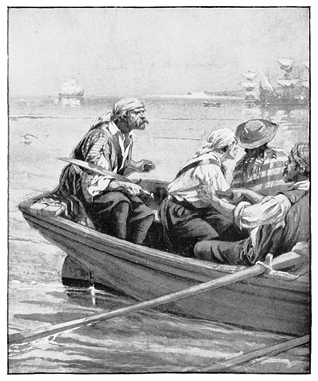
Instead of taking the newcomer during daylight, Cocklyn and his men launched their attack after seven o’clock in the evening when Snelgrave anchored in the river. An hour later, he and his officers were dining below when
the Officer of the Watch upon Deck, sent me word, “He heard the rowing of a Boat.” Whereupon we all immediately went upon Deck; and . . . I ordered Lanthorns and Candles to be got ready . . . I ordered also, by way of Precaution, the first Mate to go into the Steerage, to put all things in order, and to send me forthwith twenty Men on the Quarter-deck with fire Arms and Cutlaces, which I thought he went about.
. . . I could not yet see the Boat, but heard the noise of the rowing very plain: Whereupon I ordered the second Mate to hail the Boat, to which the People in it answered, “They belonged to the Two Friends, Captain Eliot of Barbadoes.” At this, one of the Officers who stood by me, said, “He knew the Captain very well, and that he commanded a Vessel of that name.” I replied, “It might be so; but I would not trust any Boat in such a place . . . .” (Snelgrave, 201-203)
At this juncture, the first mate should have returned with armed men, but had not. Snelgrave sent another officer below to hurry them up.
By this time our Lanthorns and Candles were brought up, and I ordered the Boat to be hailed again: To which the People in it answered, “They were from America:” And at the same time fired a volley of small Shot at the Ship, tho’ they were then above Pistol shot from us; which showed the Boldness of these Villains: For there was in the Boat only twelve of them, as I understood afterwards, who knew nothing of the Strength of our Ship; which was indeed considerable, we having 16 Guns, and 45 Men on board. (Snelgrave, 203) |
|
| Back to top |
|
|
Salty Dog
Sailing Master
Posts: 10063
192187 Gold -
more...
|
| Posted: Tue Sep 22, 2020 1:53 am Post subject: |
|
|
the Officer of the Watch upon Deck, sent me word, “He heard the rowing of a Boat.” Whereupon we all immediately went upon Deck; and . . . I ordered Lanthorns and Candles to be got ready . . . I ordered also, by way of Precaution, the first Mate to go into the Steerage, to put all things in order, and to send me forthwith twenty Men on the Quarter-deck with fire Arms and Cutlaces, which I thought he went about.
. . . I could not yet see the Boat, but heard the noise of the rowing very plain: Whereupon I ordered the second Mate to hail the Boat, to which the People in it answered, “They belonged to the Two Friends, Captain Eliot of Barbadoes.” At this, one of the Officers who stood by me, said, “He knew the Captain very well, and that he commanded a Vessel of that name.” I replied, “It might be so; but I would not trust any Boat in such a place . . . .” (Snelgrave, 201-203)
At this juncture, the first mate should have returned with armed men, but had not. Snelgrave sent another officer below to hurry them up.
By this time our Lanthorns and Candles were brought up, and I ordered the Boat to be hailed again: To which the People in it answered, “They were from America:” And at the same time fired a volley of small Shot at the Ship, tho’ they were then above Pistol shot from us; which showed the Boldness of these Villains: For there was in the Boat only twelve of them, as I understood afterwards, who knew nothing of the Strength of our Ship; which was indeed considerable, we having 16 Guns, and 45 Men on board. (Snelgrave, 203)
(He later learned that they dared to attack because they thought his ship’s armament was inconsequential. They also assumed that since their earlier seizures had gone so well, so would this one. After all, crewmen were more likely to join the pirates than fight them.)
When they first began to fire, I called aloud to the first Mate, to fire at the Boat out of the Steerage Port-holes; which not being done, and the people I had ordered upon Deck with small Arms not appearing, I was extremely surprized; and the more, when an Officer came and told me, “The People would not take Arms.” I went thereupon down into the Steerage, where I saw a great many of them looking at one another . . . . I asked them with some Roughness, “Why they had not obeyed my Orders?” Calling upon some brisk Fellows by name, that had gone a former Voyage with me, to defend the Ship, saying, “It would be the greatest Reproach in the World to us all, if we should be taken by a Boat.” Some of them replied, “They would have taken Arms, but the Chest they were kept in could not be found.”
. . . By this time the Boat was along the Ship’s Side, and there being no body to oppose them, the Pirates immediately boarded us; and coming on the Quarter-deck, fired their Pieces several times down into the Steerage; and shot a Sailor . . . of which Wound he died afterwards. They likewise threw several Granado-shells, which burst amongst us, so that ’tis a great wonder several of us were not killed by them, or by their Shot.
At last some of our People bethought themselves to call out for Quarter: which the Pirates granting, the Quarter-master came down into the Steerage, enquiring, “Where the Captain was?” I told him, “I had been so till now.” Upon that he asked me, “How I durst order my People to fire at their Boat out of the Steerage? saying, that they had heard me repeat it several times.” I answered, “I thought it my Duty to defend the Ship, if my People would have fought.” Upon that he presented a Pistol to my Breast, which I had but just time to parry before it went off; so that the Bullet past between my Side and Arm. The Rogue finding he had not shot me, he turned the But-end of the Pistol, and gave me such a Blow on the Head as stunned me; so that I fell upon my Knees; but immediately recovering my self, I forthwith jumped out of the Steerage upon the Quarter-deck, where the Pirate Boatswain was. (Snelgrave, 204-206) |
|
| Back to top |
|
|
Salty Dog
Sailing Master
Posts: 10063
192187 Gold -
more...
|
| Posted: Tue Sep 22, 2020 1:53 am Post subject: |
|
|
The four lanterns that illuminated the deck revealed a pirate armed with a broad sword. He believed that since Snelgrave had dared to order his men to fire upon the pirates, no quarter should be given.
. . . aiming at the same time a full stroke at my Head. To avoid it I stooped so low, that the Quarter-deck Rail received the Blow; and was cut in at least an inch deep: Which happily saved my Head from being cleft asunder: And the Sword breaking at the same time . . . prevented his cutting me to pieces.
By good Fortune his Pistols, that hung at his Girdle, were all discharged . . . [b]ut he took one of them, and with the But-end endeavoured to beat out my Brains . . . . (Snelgrave, 206-207)
Snelgrave’s crew came to his rescue and told the pirates that he was a good captain who didn’t deserve death. Heeding their request, the pirates celebrated their capture by firing their weapons into the air, and soon, their mates arrived aboard their ship, which had slipped down the river just in case Snelgrave and his men had resisted. |
|
| Back to top |
|
|
Salty Dog
Sailing Master
Posts: 10063
192187 Gold -
more...
|
| Posted: Tue Sep 22, 2020 1:55 am Post subject: |
|
|

Part 2
Among the many pirates that William Snelgrave encountered was one whom he had actually met long ago at school. James Griffin was now “a tall man, with four Pistols in his Girdle, and a broad Sword in his Hand.” (Snelgrave, 214) Although Snelgrave recognized Griffin, past experience had proved it was never a good idea to acknowledge that because “it had proved fatal to some who had been taken by Pirates.” (Snelgrave, 214) The pirate described boyhood pranks that they had played, but Snelgrave feigned ignorance of those as well. Griffin finally explained why he had approached his former friend.
“He supposed I took him to be one of the Pirate’s Crew, because I saw him armed . . . but he was a forc’d Man . . . obliged . . . to act as Master of the Pirate-ship; and the reason of his being so armed, was to prevent their imposing on him; for there was hardly any amongst the Crew of Pirates belonging to Captain Cocklyn, but what were cruel Villains; misusing much better Men than themselves, only for having the Misfortune to fall into their Hands . . . . (Snelgrave, 215)
He promised to watch over Snelgrave during the coming drunken revelry. Only then did Snelgrave own up to knowing his friend. Griffin’s protection proved a good thing, for a soused pirate, armed with a cutlass, approached Snelgrave while he slept in a hammock. When Griffin asked his purpose, the pirate responded, “To slice my Liver, for I was a vile Dog.” (Snelgrave, 218) In spite of a warning to cease and desist, the pirate raised his sword as if to cleave Snelgrave’s head from his shoulders. Griffin intervened with his own blade, and the pirate scampered away.
The next morning Snelgrave finally discovered why his first mate had failed to carry out his orders, which resulted in the capture of the Bird Galley. Married to a woman the first mate “could not love” and, facing unfortunate trouble should he return home, Simon Jones saw the arrival of the pirates as an opportunistic happenstance. They offered him a chance to escape his quagmire, so he and ten others “signed their Articles.” |
|
| Back to top |
|
|
Salty Dog
Sailing Master
Posts: 10063
192187 Gold -
more...
|
| Posted: Tue Sep 22, 2020 1:56 am Post subject: |
|
|
Several days later, some of the ten crewmen who had gone on the account thought better of that hasty decision and wished to rejoin Snelgrave. They wanted him to speak on their behalf; for them to do so meant certain death. Although he refused to become involved, some of them explained why the chest of arms had gone missing.
[T]he Morning we made Land, I ordered the Steerage to be clean’d; to do which all the Chests there were carried between Decks; and after the Steerage was clean’d, all the Chests were brought back again in their places, except the Chest of Arms, which was left behind by the Mate’s Order. (Snelgrave, 222)
When the crew came looking for the chest the night the pirates attacked, Mr. Jones told them, “This was an opportunity he had wished for; and that if they fired a Musquet, they would be all cut to pieces.” (Snelgrave, 222) With this information, as well as further divulgences of the crew later on, Snelgrave was surprised that he had survived the ordeal at all.
Somewhat later in his captivity, Snelgrave described an incident in which his former first mate shared a suggestion with the pirates. The Dispatch, a Company vessel under the command of Captain Wilson, had the misfortune to venture up the river where the pirates were anchored.
Mr. Simon Jones . . . told them . . . “That he had once commanded a Ship, which was hired and freighted by the African Company; and that he had been very unjustly used by them; so he desired the Dispatch might be burned, that he might be revenged of them.” This being immediately consented to, and forthwith ordered to be executed, one John Stubbs, a witty brisk fellow, stood up, and desired to be heard first; saying, “Pray, Gentlemen, hold a little, and I will prove to you, if this Ship is burnt, you will thereby greatly serve the Company’s Interest.” This drawing every one’s attention, they bid him go on: Then he said, “The Vessel has been out these two years on her Voyage, being old and crazy, and almost eaten to pieces by the Worms; besides, her Stores are worth little; and as to her Cargoe, it consists only of a little Redwood and Melegette-pepper; so if she should be burned, the Company will lose little; but the poor People that now belong to her, and have been so long a Voyage, will lose all their Wages, which, I am sure, is three times the Value of the Vessel, and of her trifling Cargoe; so that the Company will be highly obliged to you for destroying her.” The rest of the Crew being convinced by these Reasons, the Vessel was spared, and delivered again to Captain Wilson and his People, who afterwards came safe to England in it. (Snelgrave, 275-276) |
|
| Back to top |
|
|
Salty Dog
Sailing Master
Posts: 10063
192187 Gold -
more...
|
| Posted: Tue Sep 22, 2020 1:58 am Post subject: |
|
|
In the end, the pirates gave Snelgrave Le Vasseur’s old ship, as well as unused stores that they didn’t want or had no need of. When they held an auction of the remainder of his cargo and possessions, “several of the Pirates bought many Necessaries that had been mine, and gave them to me.” (Snelgrave, 276-277) Then, on the last day of April, the pirates sailed away, leaving behind Snelgrave, his men who hadn’t joined the pirates, and his surgeon.
When Snelgrave later wrote about his career, the slave trade, and the pirates, he also summarized what happened to his schoolmate Griffin and Howell Davis, whom he referred to as “my generous Friend.” (Snelgrave, 280) Griffin slipped over the side of his ship one night and went ashore at Cape Coast Castle. He found a merchant ship bound for Barbados whose master agreed to take him along as a passenger. After he landed in the West Indies, he fell ill and died.

Map that accompanied Captain Snelgrave's A New Account of Some Parts of Guinea and the Slave-Trade (1734)
[Source: Yale University's A Voyage through the Worlds of the Slave Trade Robert Harms] |
|
| Back to top |
|
|
Salty Dog
Sailing Master
Posts: 10063
192187 Gold -
more...
|
| Posted: Tue Sep 22, 2020 1:59 am Post subject: |
|
|
Davis, who eventually parted ways with his fellow captains, tried to put one over on the governor of a Portuguese island in the Bay of Guinea. The governor was wiser than expected and arranged an ambush, in which Davis was killed from five gunshots.
The Boat’s Crew hearing the firing, put off in good time at some distance from the Shore; and seeing the Portuguese advancing to fire at them, they rowed on board their Ship; where relating what had happened, as they supposed, to their Captain, and to the rest left on Shore, it set the Pirates all in a flame; and they directly chose Roberts for their Commander, vowing a severe revenge on the Portuguese. . . .

Retreat of the Pirates and Death of Captain Davis from Charles Ellms' The Pirates Own Book (1837)
[Source: Dover Clip Art] |
|
| Back to top |
|
|
Salty Dog
Sailing Master
Posts: 10063
192187 Gold -
more...
|
| Posted: Tue Sep 22, 2020 2:02 am Post subject: |
|
|
Thus fell Captain Davis, who (allowing for the Course of Life he had been unhappily engaged in) was a most generous humane Person. And thus Roberts arose, who proved the reverse of him, and did afterwards a great deal of mischief in the West Indies, and on the Coast of Guinea . . . . (Snelgrave, 284-285)
Snelgrave arrived in Bristol on 1 August 1719, where he received a letter from the ship’s owner. He was given a new ship to command and his men were given money to make their way to their own homes elsewhere in England.
Prior to 1718, the RAC’s directors shied away from any governmental or naval interference or intrusion into their business. They had no need for the navy to patrol the African coast, but the depredations wrought by pirates like Davis, Cocklyn, and Le Vasseur changed their minds and the RAC entered into negotiations with the Admiralty in an effort to thwart the pirates and stop the excessive outflow of money from their coffers. As a result of these negotiations, the Royal Navy would provide two warships to escort RAC convoys from London to Africa in exchange for the Company footing the bill. At the same time, the Company directors decided that in case of an attack on RAC property, wounded agents would receive stipends. If any were “killed in defence of any of the Company’s Factorys or ships which shall be attacked by pirates or any other enemies,” the money would be given to their families. (Burl, 143)
In accordance with these new arrangements, HMS Swallow and HMS Weymouth escorted eleven Company ships from London on 5 February 1720. The commanders of these two vessels were, respectively, Chaloner Ogle and Mungo Herdman.

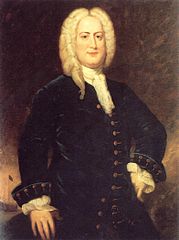
Top: HMS Swallow (etching from naval surgeon John Atkins' Guinea, Brasil, and the West-Indies (1735)
Bottom: Chaloner Ogle by an unknown artist c. 1746.
[Source: Wikimedia Commons / Wikimedia Commons] |
|
| Back to top |
|
|
Salty Dog
Sailing Master
Posts: 10063
192187 Gold -
more...
|
| Posted: Tue Sep 22, 2020 2:02 am Post subject: |
|
|
Two years passed before Bartholomew Roberts returned to the coast of West Africa; by then he was considered notorious.3 At Sierra Leone, he heard about the two Royal Navy warships of sixty guns each that were plying the waters around Guinea. The news did nothing to sway him from his depredations.
After leaving Sierra Leone at the end of August 1721, Roberts encountered the Onslow, a frigate belonging to the RAC. He converted her for his own, added fourteen additional guns so that she mounted forty in all, and rechristened her, Royal Fortune – the last of his prizes to carry that name. In the new year, on 11 January, he and his men sailed into Ouida (also called Whydah), not far from where Cape Coast Castle, the grandest and most fortified of the RAC’s trading posts, was located. This structure had four bastions, parapets atop fourteen-foot thick walls, and around seventy cannons, most of which were aimed where ships anchored. The Swedes were the original builders of the complex, but the English took control of the Castle in 1664, and it soon became the RAC’s headquarters outside of England. Captain Thomas Phillips of the Hannibal once wrote:
The castle of Cabo Corce is the chief of all those our African company have upon this coast . . . This castle has a handsome prospect from the sea, and is a very regular and well-contriv’d fortification, and as strong as it can be well made . . . being encompass’d with a strong and high brick wall, thro’ which you enter by a well-secur’d and large gate facing the town, and come into a fine spacious square wherein 4 or 500 men may very conveniently be drawn up and exercis’d. It has four flankers which have a cover’d communication with each other, and are mounted with good guns; and over the tank is a noble battery of fifteen whole culverin and demy cannon, lying low, and pointing upon the road, where they do good execution upon any ships that should pretend to attack the castle . . . . Under this battery is a curious tank or cistern which will contain 400 tons of water, being with great labour cut in a long square out of a rock, and terrass’d over, having a convenient pair of stairs to descend into it to fetch the water.
. . . In this castle the agents and factors have genteel convenient lodgings; and as to the soldiers, I believe there are not better barracks any where than here, each two having a handsome room allow’d them . . . The castle has in all about forty guns mounted, some of them brass, and commonly 100 white men in garrison, with a military land officer to discipline and command them under the agents. He is the lieutenant of the castle, but is call’d by the title of captain . . . .
In the castle there is one spacious warehouse, and several smaller ones; a convenient trunk or place for the slaves to live in by themselves; a good forge with smiths . . . .
There are two gardens belong to the castle, one of which is large, full of lime and orange trees . . . In the middle of our castle garden is a square summer-house built, where the agents sometimes enjoy themselves. . . . The other is nearer the castle, and is call’d Black Jack’s garden, having nothing therein but cocoa-nut trees. This is the burying place of our factors and white men that die there, except the agents and some others, who . . . are buried in by-places in the castle. (Phillips, 204-205) |
|
| Back to top |
|
|
|
|
You cannot post new topics in this forum
You cannot reply to topics in this forum
You cannot edit your posts in this forum
You cannot delete your posts in this forum
You cannot vote in polls in this forum
|
Powered by phpBB © 2001, 2005 phpBB Group |
|


