
The Royal African Company and Pirates
| View previous topic :: View next topic |
| Author |
Message |
Salty Dog
Sailing Master
Posts: 10063

192187 Gold -
         more... |
 Posted: Tue Sep 22, 2020 2:03 am Post subject: |
 |
|
These accommodations contrasted greatly with those that the slaves and pirates endured.
In the Area of this Quadrangle, are large Vaults, with an iron Grate at the Surface to let in Light and Air on those poor Wretches . . . who are chained and confined there till a Demand comes. (Atkins, 9

Map of Cape Coast Castle (1869)
[Source: Wikimedia Commons] |
|
| Back to top |
|
 |
Salty Dog
Sailing Master
Posts: 10063
192187 Gold -
more...
|
| Posted: Tue Sep 22, 2020 2:04 am Post subject: |
|
|
The person in charge was the captain or agent general, and he oversaw the merchants, clerks, workers, and soldiers stationed here. Fifty to 100 men comprised the garrison, but there was frequent turnover from disease and new recruits had to be shipped in from England. The primary exports were gold, slaves, ivory, and redwood. The RAC existed for eighty years and during that time, it transported 100,000 slaves to colonies in the New World.
After the pirates plundered Ouidah, they went to the roadstead where ships anchored. Captain Ogle wrote in a letter to the Admiralty on 5 April 1722:
On my Arrival at Whydah I was informed that two Pyrate Ships, one of 40 and another of 24 Guns commanded by one Roberts had been there, and had sailed about 26 Hours before: I found ten sail of Ships in the Road, two of which were English, three French, and five Portugueze, they had all ransomed at the Rate of eight Pounds Weight of Gold each; an English Ship, for refusing to ransom the Pyrates had been burnt with a considerable Number of Negroes a-board. (Tryals, 3:76) |
|
| Back to top |
|
|
Salty Dog
Sailing Master
Posts: 10063
192187 Gold -
more...
|
| Posted: Tue Sep 22, 2020 2:05 am Post subject: |
|
|

After the pirates plundered Ouidah, they went to the roadstead where ships anchored. Captain Ogle wrote in a letter to the Admiralty on 5 April 1722:
On my Arrival at Whydah I was informed that two Pyrate Ships, one of 40 and another of 24 Guns commanded by one Roberts had been there, and had sailed about 26 Hours before: I found ten sail of Ships in the Road, two of which were English, three French, and five Portugueze, they had all ransomed at the Rate of eight Pounds Weight of Gold each; an English Ship, for refusing to ransom the Pyrates had been burnt with a considerable Number of Negroes a-board. (Tryals, 3:76)
Bartholomew Roberts off the coast of AfricaTwo days later, Roberts intercepted a note intended for the RAC’s agent in Ouidah. It mentioned that HMS Swallow was dogging the pirate captain and his men. Roberts departed the area forty-eight hours before Ogle arrived. The British captain pursued posthaste. Around daybreak on 5 February, the navy ship sighted three ships – Royal Fortune, Great Ranger, and Little Ranger – at anchor. Unable to defend himself against all three, Ogle hauled off in hopes that one would pursue Swallow. Roberts thought this stranger was a merchantman and ordered Great Ranger to go after her.
[I]n less than an Hour one of the three got under Sail and gave me Chace; and I, to give her a fair Opportunity of coming up with me without being discovered, kept on the same Course, with the same Sail abroad I had when I first saw her: About eleven that Morning she got within Gun-shot of me and fired several Chace Guns, under English Colours and a black Flag at her Mizzen-Peek; soon afterwards being come within Musket shot, I Starboarded my Helm and gave her a Broad-side, and in an Hour and an half’s Time she struck and called for Quarter, we having disabled her very much, and shot down her Man-Top-Mast . . . . (Tryals, 3:77)
The casualties among the pirates was high: ten killed and sixteen out of twenty badly wounded, including their captain whose name was Skyrm. Having had his leg shot off, he surrendered. Several pirates fled below to blow up their ship, but found an insufficient amount of gunpowder to accomplish the job. The resulting explosion merely killed one man and the other five received severe flash burns. |
|
| Back to top |
|
|
Salty Dog
Sailing Master
Posts: 10063
192187 Gold -
more...
|
| Posted: Tue Sep 22, 2020 2:06 am Post subject: |
|
|
When Ogle’s men boarded Great Ranger, they discovered fifty-nine English and eighteen French pirates, and twenty-three slaves. The majority of these 100 men were injured. Ogle ordered the pirate ship repaired and sent the wounded ashore under guard. The remainder of the rogues were put in irons and taken aboard Swallow. Then Ogle set sail to deal with Roberts and the rest of his men.
To be continued . . . |
|
| Back to top |
|
|
Salty Dog
Sailing Master
Posts: 10063
192187 Gold -
more...
|
| Posted: Tue Sep 22, 2020 2:06 am Post subject: |
|
|
Notes:
1. No proof exists that these words ever came from Magellan. They have been traced back to a nineteenth-century lawyer named Robert G. Ingersoll, who wrote: “It is a blessed thing that in every age some one has had individuality enough and courage enough to stand by his own convictions – someone who had the grandeur to say his say. I believe it was Magellan who said, ‘The church says the earth is flat; but I have seen its shadow on the moon, and I have more confidence even in a shadow than in the church.’ On the prow of his ship were disobedience, defiance, scorn, and success.”
2. Mulct was a fine, a tax, or compulsory payment. The wooden horse was akin to a saw horse that the man straddled. Once atop this contraption, weights were attached to his ankles.
3. It has been estimates that Roberts earned nearly £15,000,000 during his career, based on the purchasing power of the pound in 2005. |
|
| Back to top |
|
|
Salty Dog
Sailing Master
Posts: 10063
192187 Gold -
more...
|
| Posted: Wed Oct 21, 2020 12:47 am Post subject: |
|
|
Part 3
On the morning of 10 February 1722, Bartholomew Roberts was breaking his fast when the lookout spotted an approaching vessel. He disregarded the intruder, until one of his men, a navy deserter, recognized her as the Swallow. Roberts summoned his men on Little Ranger to join their comrades on the flag ship; by 10:30 all were at their stations and armed. Royal Fortune
came down upon me, with English Ensign and Jack, and a black Pendant flying at her Main-top-mast-head, and I shewed her a French Ensign, when she came within Pistol shot I hoisted my proper Colours and gave her a Broadside, which she returned, and endeavoured to get from me, by making all the Sail she could, but in less than two Hour shot her Main-top-mast down, and than she struck, her Mizzen-top-mast being shot away some time before: The Captain, whose Name was Roberts, was killed, his Prize . . . had . . . 152 Men, 25 of whom were Negroes. (Tryals, 3:77)
The man once reticent to become a pirate was dead; grapeshot had torn open his throat. Roberts far surpassed his mentor, Howell Davis, in both his plundering and his notoriety. His death was quick. Those of his men would not be. Ogle sailed to Cape Coast Castle, where the pirates were imprisoned in a slave hole carved out of solid rock beneath the fortress.4


Cape Coast Castle: Top -- courtyard of fortress. Bottom -- underground slave pen similar to the cell that would have held the captured pirates |
|
| Back to top |
|
|
Salty Dog
Sailing Master
Posts: 10063
192187 Gold -
more...
|
| Posted: Wed Oct 21, 2020 12:48 am Post subject: |
|
|
The trials of the captured pirates began in the Castle’s great hall on 28 March 1722. (Nineteen of the 254 had already died.) If any scoundrel thought he would receive an unbiased trial, such ideas were quickly quashed. The Weymouth’s Captain, Mungo Herdman, was chosen to head the court hearing the cases. Many of the other members were either RAC masters or agents from the factories and forts that the pirates had looted: the Honorable James Phipps, Esquire (General of the Coast); Henry Dodson and Francis Boye (merchants), Edmund Hyde (RAC Secretary), John Barnsley, and Lieutenant Charles Fanshawe. Another lieutenant, John Atkins, was the court’s register.
Forty-eight pirates heard the same sentence that Valentine Ashplant, Richard Hardy, William Magness, Christopher Moody, David Simpson, and Thomas Sutton heard on 31 March 1722:
Ye and each of you are adjudged and sentenced to be carried back to the Place from whence ye came, from thence to the place of Execution without the Gates of the Castle, and there within the Flood-marks to be hanged by the Neck ’till ye are Dead, Dead, Dead; And the Lord have Mercy on your Souls.
After this ye and each of you shall be taken down, and your Body hung in Chains. (Tryals, 3:102)
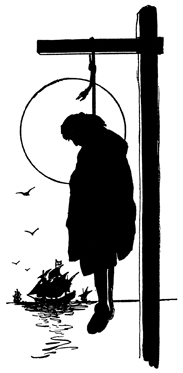
welve . . . .” (Tryals, 3:102)
Each defendant was offered the chance to speak at his trial. Sutton concurred with the two ships’ masters who testified against him, although he did correct one of them, who claimed he had taken all the gunner’s stores when he actually only took “half the Stores out.” (Tryals, 3: 94) He also stated that he had been with Roberts for three years.
Benjamin Kraft, who commanded the Gertruyt and was one of three men who testified against Magness, identified him as a pirate quartermaster. In his defense, he said that being the quartermaster “obliges him to go on Board . . . Prizes, [but this] was imposed on him, and that it always went against his Conscience to do them.” (British, 3:94) The judges didn’t buy his argument.
Of Simpson, Edward Crisp of the Onslow said, “the Prisoner was particularly cruel beyond the rest of the Pyrates, driving them about with his Cutlass, and bragging he was as good a Man as Roberts.” (British, 3:94) Gerrit de Haen swore that Simpson “said, If all were of my Mind, we’d burn or sink” his ship.” (Tryals, 3:94) There were other witnesses who could have testified against Simpson, but he didn’t deny what those who did speak said. He only wished to add that he had been forced into piracy and did no worse than many other pirates were doing. The Court, however, knew him to be a pirate of long standing and that he had once been “Quarter-Master ’till he was turn’d out . . . .” (Tryals, 3:94) |
|
| Back to top |
|
|
Salty Dog
Sailing Master
Posts: 10063
192187 Gold -
more...
|
| Posted: Wed Oct 21, 2020 12:48 am Post subject: |
|
|
One of the witnesses against Hardy was Thomas Castles, who swore in his deposition
That the 5th of January, about two Leagues from Assinee on the Coast of Africa, he being then on his Affairs in the Diligence Sloop belonging to the African Company, Roberts the Pyrate, and his Consort, two Ships of them took the same Sloop, and that he is positive of the Prisoner being one, and the busiest one among the Pyrates at plundering, taking the Gold and the Captain’s Buckles, who he swore should suffer for denying he had any Silver: And after this, that he was the Man that scutled the Sloop and sunk her. (Tryals, 3:95)
John Wingfield, who had sailed aboard another RAC vessel called Hannibal, swore that Hardy “not only robb’d the Ship, broke the Hinges of a Case to get the Gold out, directed the Pyrates to throw the Red-Wood that was in the Brigantine over Board, but broke his Cutlass with a Blow he gave the Master of her.” (Tryals 3:95)
Moody acknowledged the truth of what the witnesses said against him, but Ashplant merely said that he had been forced into spending two years with the pirates.
On this particular day, 31 March, ten other pirates were also tried with these men. One was acquitted, eight were found guilty – although one of these had his sentence stayed until “the King’s Pleasure be known” – and one was sentenced to serve time in London’s Marshalsea Prison. (Tryals, 3:96) The court adjourned until the next day.
This was the largest trial of pirates ever held. Eighteen Frenchmen were judged not guilty because they had been forced to join the pirates. Another seventy-four were also acquitted. Of those convicted of piracy, fifty-four were to be executed – two of whom received reprieves; seventeen were sent back to London’s Marshalsea Prison to learn of their sentences – thirteen of whom died before reaching England; and twenty petitioned the court with a request that ultimately amounted to a death sentence since the Gold Coast (Ghana) was one of the unhealthiest regions of Africa for Europeans.
That your Petitioners being unhappily, and unwarily drawn into that wretched and detestable Crime of Pyracy, for which they stand now justly condemned, they most humbly pray the Clemency of the Court, in the Mitigation of their Sentence, that they may be permitted to serve the Royal African Company of England, in this Country for seven Years, in such Manner as the Court shall think proper; that by their just Punishment, being truly sensible of the Error of their former Ways, they will for the future become faithful Subjects, good Servants, and useful in their Stations, if it shall please the Almighty to prolong their Lives. (Tryals, 159) |
|
| Back to top |
|
|
Salty Dog
Sailing Master
Posts: 10063
192187 Gold -
more...
|
| Posted: Wed Oct 21, 2020 12:49 am Post subject: |
|
|
After consulting with the Company’s Captain General, the court resolved that their sentences would be commuted to servitude as requested. It would be up to the RAC to determine where they would serve, but there were a number of gold mines that needed laborers. One of these indentures, signed and sealed, read:
This Indenture made the twenty sixth Day of April, Anno Regni Regis Georgii . . . Between Roger Scot, late of the City of Bristol Mariner, of the one Part, and the Royal African Company of England, their Captain General and Commander in chief for the time being of the other Part, Witnesseth, that the said Roger Scot, doth hereby Covenant, and agree to, and with, the said Royal African Company, their Captain General, and Commander in chief for the Time being, to serve him, or his lawful Successors, in any of the Royal African Companies Settlements on the Coast of Africa . . . to the full End and Term of seven Years, from hence next ensuing fully to compleat, and ended, there to serve in such Employment, as the said Captain General or his Successors shall employ him, according to the Custom of the County in like Kind.
In Consideration whereof, the said Captain General, and Commander in chief doth Covenant, and agree to and with the said Roger Scot, to find and allow him, Meat, Drink, Apparel, and Lodging, according to the Custom of the Country. (Tryals, 3:160)
At the appointed time of their hangings, the pirates were escorted to their execution by Company soldiers. Among those present to watch were RAC employees, as well as visitors and local Africans. It took more than two weeks to hang the condemned men; the last group danced the hempen jig on 20 April 1722. Eighteen of the dead were tarred and banded with iron before being gibbeted on three hills outside the Castle. The deserter turned pirate who had recognized H. M. S. Swallow wasn’t tried with his comrades. Thomas Armstrong fell under the navy’s jurisdiction and was imprisoned aboard Weymouth until his court-martial, after which he was found guilty, had a noose placed around his neck, and was hauled up to the yardarm.
Around the time when Roberts returned to plunder the African coast, a new pirate became active. His name was George Lowther, and he worked for the RAC at the time that he went on the account in May 1721. Several months prior, he had departed England aboard a sixteen-gun Company ship called the Bumper Galley. He was the second mate and one of a crew of thirty serving under her master, Charles Russell. At the time of their departure, soldiers accompanied them. One of these was Captain John Massey.
The Royal African Company making Choice of him for their chief Engineer, in order to their erecting a new Fort in Africa, the old one being either demolish’d or impair’d, he set out from England . . . in a very good Ship belonging to the Company . . . . (Select, 272)
[img]
http://www.cindyvallar.com/Lowtherc.jpg[/img] |
|
| Back to top |
|
|
Salty Dog
Sailing Master
Posts: 10063
192187 Gold -
more...
|
| Posted: Wed Oct 21, 2020 12:50 am Post subject: |
|
|
The fort he and his fellow soldiers were assigned to lay along the River Gambia. What they didn’t know at the time they left London was just how devastating the pirates’ rampage had been. They had plundered the fort and factory of everything having value, including the gold ingots and ivory stored in the treasure room. Nor could the soldiers know the terrible toll the journey to Africa would exact. Aboard Bumper Galley, the ship’s master, Captain Russell, and his officers withheld food and wine from them, which resulted in many of Massey’s officers and soldiers falling ill and dying. In fact, he was the only officer among the garrison who survived the voyage. Upon arriving in Africa, he and his men drank some water, which made them sick.
The Bumper Galley arrived at James’s Island (Kunta Kinteh Island), around eighteen miles upriver. Another ship also arrived that carried the new governor, Colonel Whitney. The conditions Massey and his men encountered on land in no way measured up to promises made to them in London. The comfortable quarters Massey expected didn’t exist, which meant he and his men had to remain cooped up on the ship even longer than expected. The RAC’s factors and merchants, who were responsible for supplying food, proved stingy, denying them the promised ample provisions. Massey likened these circumstances to being no better than that of a “Guiney slave,” but the merchants and factors held greater sway, and the governor, who was indisposed aboard ship for three weeks, would do nothing to alleviate the mounting tension.
While this rift was taking place ashore, another rose on the Bumper Galley. Second Mate Lowther, who didn’t always see eye to eye with the master, spent a lot of time currying favor with the crew. When Captain Russell blamed Lowther for an accident and ordered him to be punished, at least some of them grabbed handspikes and threatened bodily harm to any man who dared to lay hands on the second mate. This merely served to widen the rift between Lowther and Captain Russell. |
|
| Back to top |
|
|
Salty Dog
Sailing Master
Posts: 10063
192187 Gold -
more...
|
| Posted: Wed Oct 21, 2020 12:50 am Post subject: |
|
|
It wasn’t long before Lowther reconnected with Massey and the two commiserated about their situations and shared resentments. From the latter’s perspective, he
had then a very dismal Prospect before him, his Countrymen lying all Dead about him, his Victuals all wasted, no Water that he dare taste of, in a strange Part of the World, surrounded with Savages, whose Language he was a Stranger to, and no Possibility of his ever getting the Ship back to England again. (Select, 272)
Massey would later petition King George for a pardon. He wrote this document while at sea, signing it with both his name and Lowther’s, on 22 July 1721. In it, he explained what had taken place.
These frightful Omens with other sundry substantiale reasons the seamen found of Bondage, Barbarous, and Unhumane Usage from their Commander Charles Russell induc’d them to a Resolution to return home. And I finding ye Major part of the Passengers brought over in two ships Dead, and the rest at ye point of Death the Men under my Command on James Island were afflicted with sickness to a very high degree.
These Inevitable Proofes of Destruction forced me to Use my utmost Endeavour to preserve the Lives of Yr Majesty’s Dutifull subjects whose distressed Condition renders them Incapable of future service.
Therefore with humble submissions, I on Acct of they [the] Destressed Artificers and soldiers, and Mr Lowther, second Mate of the said Bumper upon acct of ye sailors, We Yr Majesty’s Dutifull subjects thought ourselves bound in Duty to Relieve those poor wretches from a Visable and Tyranicall Calamity.
Wherefore we seas’d ye sd Bumper for ye use of ye Distressed without doing this neither We nor any of our Miserable Country Men would ever had opportunity to return home . . . . (Pirates, 131-132)
Massey refused to order his men to take this drastic action; instead, he offered them a choice: stay on the island as it was, or return home to England. They opted for the second option.
To be continued . . . |
|
| Back to top |
|
|
Salty Dog
Sailing Master
Posts: 10063
192187 Gold -
more...
|
| Posted: Thu Nov 19, 2020 3:39 pm Post subject: |
|
|
Part 4
By now, Governor Whitney had recovered his health and gone ashore, but if he sensed anything amiss, he gave no indication of it. Such was not the case aboard Bumper Galley. Lowther and those who followed him grew insolent and daring enough to disobey orders.
Captain Russell already had a good idea where the situation with Lowther was headed, so he met with the governor at the RAC’s factory one morning to find a means to thwart the coming mutiny. Understanding what was up, Lowther sent a note ashore to notify Massey that it was time for him to come aboard Bumper Galley and put their plan into action. As far as Massey knew, he, Lowther, and their followers planned only to return home to England. Turning pirate wasn’t a path he ever thought of walking.
Massey rowed out to the ship that afternoon in the company of the governor’s son. The island’s provisions and eleven pipes of wine had already been brought out, which emptied the storehouse of all but two half pipes.5 His men had also dismounted the fort’s cannons so they could not be fired at the Bumper Galley. The anchor was weighed. The sails unfurled. It should have been a neat getaway, but the ship ran aground. Massey’s training kicked in, and he and sixteen men returned to shore and remounted the cannons, which were then used to prevent anyone from intervening in their escape plan. He also made certain that some factory workers helped to refloat Bumper Galley. In the meantime, Captain Russell tried to negotiate with Lowther to regain the ship, but Lowther refused to surrender, even after Russell assured him there would be no repercussions.
 |
|
| Back to top |
|
|
Salty Dog
Sailing Master
Posts: 10063
192187 Gold -
more...
|
| Posted: Thu Nov 19, 2020 3:41 pm Post subject: |
|
|
Bumper Galley finally floated free the next morning. Massey and his men spiked the cannons before dismounting them again. Then they returned to the ship. The governor’s son and several other men who were unwilling to leave went back to the island before the vessel sailed away.
Once they were surrounded by blue water, Lowther revealed his true designs albeit in a manner that convinced everyone, including Massey, that they really had no alternative but to become pirates. After all, as far as those in positions of power within the RAC were concerned, they were mutineers – a capital offense. He did offer to drop anyone who didn’t want to go on the account at the next landfall they encountered, but that wasn’t a good option and still left them liable for disobeying orders. All fifty aboard Bumper Galley voted to become pirates.
Andrew Thompson, one of the crew of the Bumper Galley, was aboard the longboat that picked up Massey and brought him out to the ship. His deposition, given on 2 March 1722, didn’t quite agree with Massey’s version, although he was a participant in the mutiny and subsequent events. While the master was ashore, Lowther ordered him and the others
to bring . . . on board the said ship Captain John Massey and between 30 and 40 soldiers who were under his . . . Comand at which time . . . the chief mate was confined to his Cabin by the sd 2d mate [Lowther] and . . . sent the Boat on Shoar again to fetch off the Wine and Provisions . . . then they sent the sd chief mate on Shoar, sailed away with the sd Ship and named her the Delivery. And as soon as they were got out at Sea they the sd Massey and Lowther and the sd Soldiers and the sd Ships Company agreed to go a pirating And took oaths and entered into Articles in Writing for that purpose and prepared black Colours. (Pirates, 141)

Louis Rhead's depiction of raising the Jolly Roger
(Source: Dover Pirates Clip Art) |
|
| Back to top |
|
|
Salty Dog
Sailing Master
Posts: 10063
192187 Gold -
more...
|
| Posted: Thu Nov 19, 2020 3:42 pm Post subject: |
|
|
to bring . . . on board the said ship Captain John Massey and between 30 and 40 soldiers who were under his . . . Comand at which time . . . the chief mate was confined to his Cabin by the sd 2d mate [Lowther] and . . . sent the Boat on Shoar again to fetch off the Wine and Provisions . . . then they sent the sd chief mate on Shoar, sailed away with the sd Ship and named her the Delivery. And as soon as they were got out at Sea they the sd Massey and Lowther and the sd Soldiers and the sd Ships Company agreed to go a pirating And took oaths and entered into Articles in Writing for that purpose and prepared black Colours. (Pirates, 141)
Hoisting a pirate flag by Louis Rhead (Source:
Dover Pirates Clip Art)
Louis Rhead's depiction of raising the Jolly Roger
(Source: Dover Pirates Clip Art)
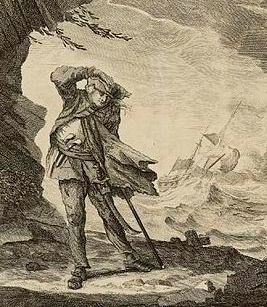
During the next seven months, Lowther, Massey, and their men captured five merchant ships. Thompson described the plundering of a French sloop.
. . . Massey and Lowther went on board . . . double armed and brought her to an Anchor by the side of the said Ship . . . and then took out of her . . . two or three and thirty Anchors of Brandy, about six hogsheads of Clarrett and about seventy pounds in Money and plundered the Master and men having first broad open the Cabin and the Chests and hatches. And they the sd Massey and Lowther locked up the sd Money in an iron bound Chest which was called the Companys Chest to the lock of which Chest there were two keys and the sd Massey kept one and the sd Lowther kept the other and the said Massey had a pair of gold Buttons which were found in a Bag amongst some of the Money, and there were ten of the Company of the sd Sloop carried on board . . . where their hands were tyed behind them and they were confined in the Roundhouse by Order of the sd Massey and Lowther and the next Day they were set at Liberty and sent on board ye sd Sloop and they hoysted the black flag . . . . (Pirates 142-143)6
 |
|
| Back to top |
|
|
Salty Dog
Sailing Master
Posts: 10063
192187 Gold -
more...
|
| Posted: Thu Nov 19, 2020 3:42 pm Post subject: |
|
|
In December 1721, Lowther met another pirate, Edward Low. Their notorious partnership lasted until 28 May of the following year, at which time they separated. While careening his vessel at Blanquilla Isle (near Venezuela), Lowther and his men were attacked by Captain Walter Moore aboard Eagle, a sloop out of Barbados. Moore captured fourteen pirates, who were tried at St. Kitts in March 1724. Lowther eluded Moore, but his body was supposedly found later with a spent pistol beside him.
Massey, on the other hand, never really acclimated to being a pirate. Upon boarding their first prize, he didn’t have a clue “how to be a Pirate” and asked Lowther what to plunder. (Select, 273) Lowther’s reply was to do whatever he wished. He would later confess that
tho’ . . . he liv’d very well, yet his Heart was uneasy, and he frequently dreamt he was in a Ship sailing to Tyburn . . . Tho’ he carry’d a smiling Countenance, . . . knowing that if the Pirates perceived in him the least Dissidence or Dislike, he was to be immediately thrown over Board, or have his Tongue cut out. (Select, 273)
Going on the account had never crossed his mind. His only desire had been to return home to London. After the Delivery arrived in the West Indies, he decided to leave this life as soon as they took another vessel. That opportunity arrived, and he and ten men, including Andrew Thompson, bid farewell to the pirates and went to Jamaica. His men scattered upon landing, but he visited Governor Nicholas Lawes and put forth his case, insisting
[t]was to save so many of his Majesty’s Subjects from perishing, and that his Design was to return to England; but Lowther conspiring with the greater part of the Company, went a pyrating with the Ship; and that he had taken this Opportunity to leave him, and surrender himself and Vessel to his Excellency. (Selinger, 139-140)
The governor felt no real harm had come from the incident and averred that he would tell London so. When invited to join Lawes in hunting for Lowther, Massey readily agreed. He remained in Jamaica until receiving the governor’s recommendation for a pardon and some money to pay his expenses. |
|
| Back to top |
|
|
|
|
You cannot post new topics in this forum
You cannot reply to topics in this forum
You cannot edit your posts in this forum
You cannot delete your posts in this forum
You cannot vote in polls in this forum
|
Powered by phpBB © 2001, 2005 phpBB Group |
|


